


Page 176 - Practical Control Engineering a Guide for Engineers, Managers, and Practitioners
P. 176
An  Underda01ped  Process   151


                  tO  .....  .
                   0
              ~
              .a  -tO
              "t;!  -20   o   •   I   •   •   I  I._,.,  J  •   •   •   •   •   I   ol   '•
              6b
                                                        II.
              ~  -30  ... •'. '' .•.
                 -40to-3     to- 2             tOO               to2

                   OF=~~--~~~~                          ..  ~.
                                              ....  ~~~  ~~
                 -50
               (U
              .!  -tOO                      .. •,,•,•:  .......  ,••
              p..                                        ol
                           0
                          0
                 -t50   ....  ,  .......... .
                 -200~~~----~~~--~~~~~~~~~~
                    to-3     to- 2    to- 1    tOO      t0 1      to2
                                     Frequency (Hz)

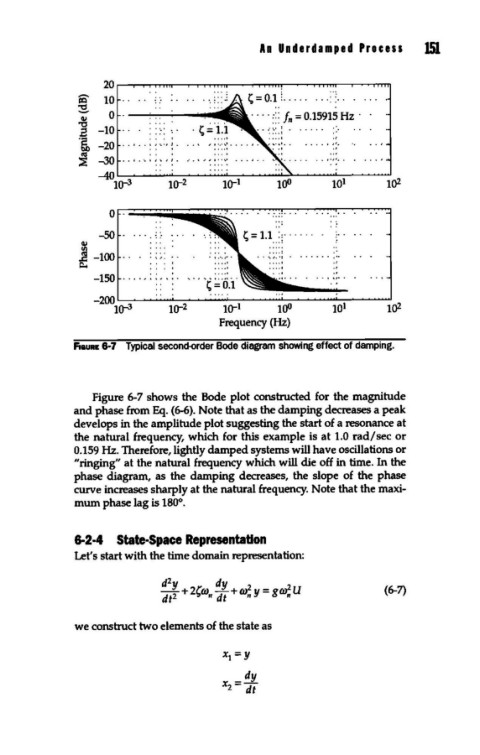
             F1cauRE 8-7  Typical second-order Bode diagram showing effect of damping.


                Figure 6-7 shows the Bode plot constructed for  the magnitude
             and phase from Eq. (6-6). Note that as the damping decreases a peak
             develops in the amplitude plot suggesting the start of a resonance at
             the natural frequency, which for this example is at 1.0  rad/  sec or
             O.t59 Hz. Therefore, lightly damped systems will have oscillations or
             "ringing" at the natural frequency which will die off in time. In the
             phase diagram, as the  damping decreases,  the  slope  of the  phase
             curve increases sharply at the natural frequency. Note that the maxi-
             mum phase lag is t80°.


             6-2-4  State-Space Representation
             Let's start with the time domain representation:


                                                                 (6-7)


             we construct two elements of the state as

