


Page 179 - Practical Control Engineering a Guide for Engineers, Managers, and Practitioners
P. 179
154  Chapter  Six


                The real negative zero at s =-I/k from Gc will not cancel either of
                                             2
             the complex conjugate poles at  -~  ± ~~ - 1 from  GP.  This suggests
             that proportional plus integral control may not have much impact
             on the complex poles that produce the underdamped behavior. The
             presence of these complex conjugate poles poses a different control
             challenge relative to  that posed  by the  single water tank and  the
             three-tank process.
                A more detailed approach will be given to tuning PI control algo-
             rithms in Chap. 11 but for control of the dashpot process with ~  = 0.1 a
             crude trial and error approach will suffice here. First, the proportional
             gain k was chosen to be unity because the process has unity gain and a
             good rule of thumb suggests that the process gain and the control gain
             be reciprocals. The integral gain was another matter. We started with
             conservative values of  I and  increased them until a semblance of  accept-
             able behavior was arrived at with I= 0.3.
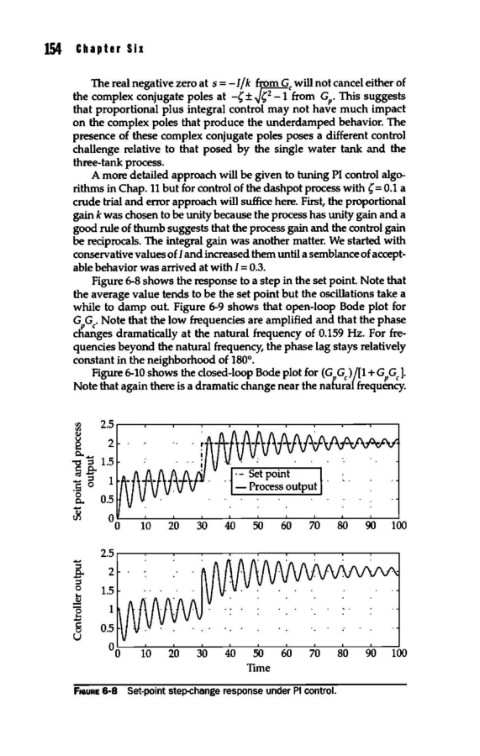
                Figure 6-8 shows the response to a step in the set point. Note that
             the average value tends to be the set point but the oscillations take a
             while to damp out. Figure 6-9  shows that open-loop Bode plot for
             GpGc. Note that the low frequencies are amplified and that the phase
             changes dramatically at the natural frequency of 0.159  Hz.  For fre-
             quencies beyond the natural frequency, the phase lag stays relatively
             constant in the neighborhood of 180°.
                Figure 6-10 shows the closed-loop Bode plot for (G  G)/[1 +G GJ
             Note that again there is a dramatic change near the nahuai frequ:Ocy.


                        10   20   30   40   50   60   70   80   90   100

                  2.5
             j     2
             ::s
             0    1.5
             .$!
             0     1
             l::
             6    0.5
             u

                                          Trme
             F1cauRE 6-8  Set-point step-change response under PI  control.

