


Page 184 - Practical Control Engineering a Guide for Engineers, Managers, and Practitioners
P. 184
An  Underdamped  Process    159


                  30
                  20
              co   10
              "'0  ...
              ~    0
              ~::...   -10
                 -20
                 -3010-3                                         1o2


                 100

              ~   50
              !IS
              -a
              ~  ...   0
              ~::...
                 -50
                -100
                    1o-3                       100
                                     Frequency (Hz)
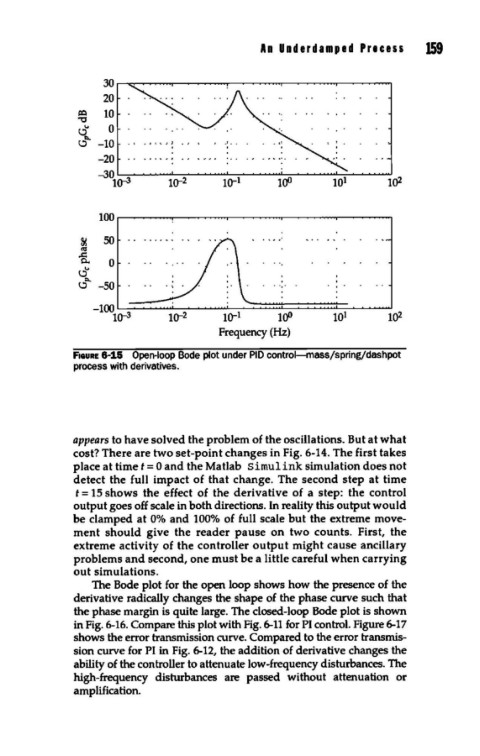
             F1aURE 6-15  Open-loop Bode plot under PID control-mass/springfdashpot
             process with derivatives.


             appears to have solved the problem of the oscillations. But at what
             cost? There are two set-point changes in Fig. 6-14. The first takes
             place at timet= 0 and the Matlab  simulink simulation does not
             detect the full  impact of that change. The second step at time
              t = 15 shows  the effect  of the derivative of a  step:  the control
             output goes off scale in both directions. In reality this output would
             be clamped at 0%  and 100% of full scale but the extreme move-
             ment  should  give  the  reader  pause  on  two  counts.  First,  the
             extreme activity of the controller output might cause ancillary
             problems and second, one must be a little careful when carrying
             out simulations.
                The Bode plot for the open loop shows how the presence of the
             derivative radically changes the shape of the phase curve such that
             the phase margin is quite large. The closed-loop Bode plot is shown
             in  Fig. 6-16. Compare this plot with Fig. 6-11 for PI control. Figure 6-17
             shows the error transmission curve. Compared to the error transmis-
             sion curve for PI in Fig. 6-12, the addition of derivative changes the
             ability of the controller to attenuate low-frequency disturbances. The
             high-frequency  disturbances  are  passed  without  attenuation  or
             amplification.

