


Page 189 - Practical Control Engineering a Guide for Engineers, Managers, and Practitioners
P. 189
164  Chapter  Six


              ~    2.5
              ~     2
              o.._   1.5
             "''::S
              ;.&  1  -----                 ..   · - · Set point   . .
             -  ;:::s          . .          ..  - Process output  :  . .
             .s  0  0.5
              0
              0..   0          . .   . . . . .   . . . . .   . . .   . .  ..
             ~    -0.50
                         10   20   30   40   50   60   70   80   90  100
                    8
             'E
             .&     6          . .   . . . . .       ...      . .  . .
              5
              ....   4
             ~      2                        ~;
             ~
              c     0~·
              0
             u
                   -2
                     0   10   20   30   40   50   60   70   80   90  100
                                          Tune
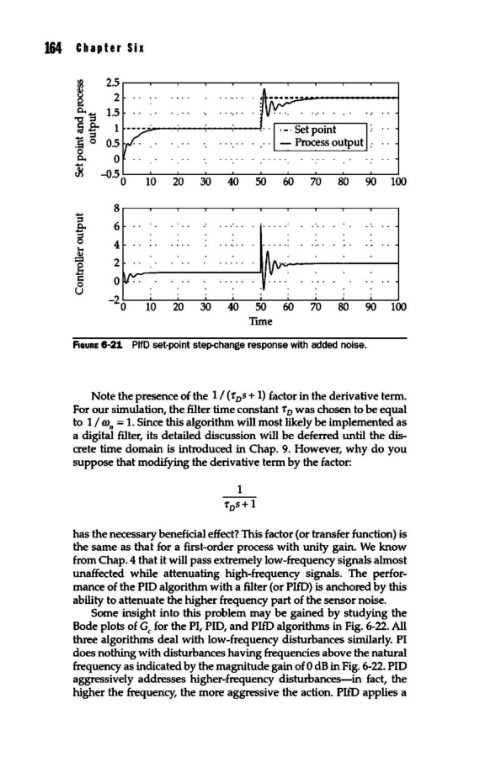
             fiGURE 6-21.  PlfD set-point step-change response with added noise.


                Note the presence of the 1 I ( r  s + 1) factor in the derivative term.
                                        0
             For our simulation, the filter time constant r  0  was chosen to be equal
             to 1 I co,  = 1. Since this algorithm will most likely be implemented as
             a digital filter,  its detailed discussion will be deferred until the dis-
             crete time domain is introduced in Chap. 9.  However, why do you
             suppose that modifying the derivative term by the factor:


             has the necessary beneficial effect? This factor (or transfer function) is
             the same as that for a first-order process with unity gain. We know
             from Chap. 4 that it will pass extremely low-frequency signals almost
             unaffected  while  attenuating  high-frequency  signals.  The  perfor-
             mance of the PID algorithm with a filter (or PlfD) is anchored by this
             ability to attenuate the higher frequency part of the sensor noise.
                Some insight into this problem may be gained by studying the
             Bode plots of Gc for the PI, PID, and PlfD algorithms in Fig. 6-22. All
             three algorithms deal with low-frequency disturbances similarly. PI
             does nothing with disturbances having frequencies above the natural
             frequency as indicated by the magnitude gain of 0 dB in Fig. 6-22. PID
             aggressively addresses higher-frequency disturbances-in fact,  the
             higher the frequency, the more aggressive the action. PlfD applies a

