


Page 193 - Practical Control Engineering a Guide for Engineers, Managers, and Practitioners
P. 193
An  Underdamped  Process    167


                Remember that the s operator takes the derivative of what fol-
                                                                 2
             lows it. Solving Eq. (6-9) for the second derivative of y, namely s y(s)
                2
                     2
             or d y/dt or y", gives
                        2
                        s y(s) = -2{ron s y(s)- ro~ y(s) + gro; ii(s)   (6-10)
                In the time domain, Eq. (6-10) would look like


                Note that ron  and g have reappeared but remember that t and y
             can always be scaled to make both quantities unity.
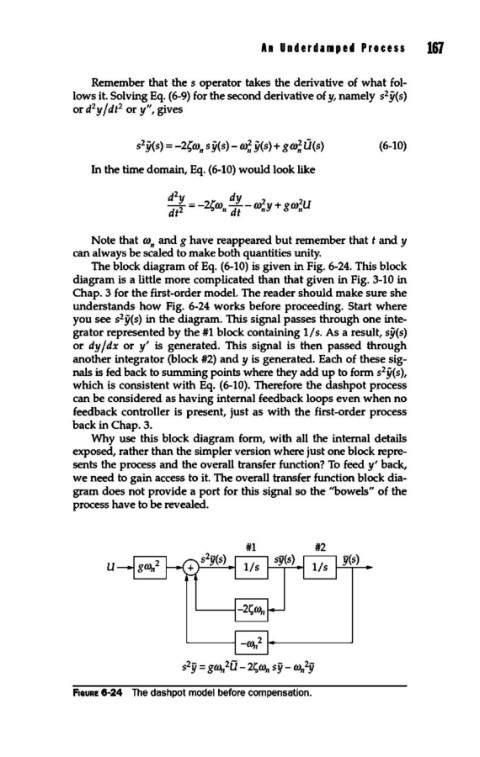
                The block diagram of Eq. (6-10) is given in Fig. 6-24. This block
             diagram is a little more complicated than that given in Fig. 3-10 in
             Chap. 3 for the first-order model. The reader should make sure she
             understands how Fig.  6-24 works before proceeding. Start where
                     2
             you see s y(s) in the diagram. This signal passes through one inte-
             grator represented by the #1 block containing 1/s. As a result, sy(s)
             or dyfdx  or  y'  is  generated.  This  signal  is  then  passed  through
             another integrator (block #2) and y is generated. Each of these sig-
                                                                2
             nals is fed back to summing points where they add up to form s y(s),
             which is consistent with Eq.  (6-10). Therefore the dashpot process
             can be considered as having internal feedback loops even when no
             feedback controller is present, just as with the first-order process
             back in Chap. 3.
                Why use this block diagram form,  with all the internal details
             exposed, rather than the simpler version where just one block repre-
             sents the process and the overall transfer function? To feed y' back,
             we need to gain access to it. The overall transfer function block dia-
             gram does not provide a port for this signal so the ''bowels" of the
             process have to be revealed.


                                          #1         #2
                                                          y(s)
                   u


             F1auRE 6-24  The dashpot model before compensation.

