


Page 188 - Practical Control Engineering a Guide for Engineers, Managers, and Practitioners
P. 188
11  llllerll••~tell  Precess   113


             I     25~--~----~-----r----~----~--~
                    2

             1i 1~ ••••••  .         .       ········'·················
             l  0.:  :.:::::t:::::::l::::::::J~~-~~.1:::::::
                0
             i  ~~           ro     ~       ~      ~       ~      M


                   10
             ~
             j.
              g     5
              ...
             &
             I      0
             u


                                           Tune
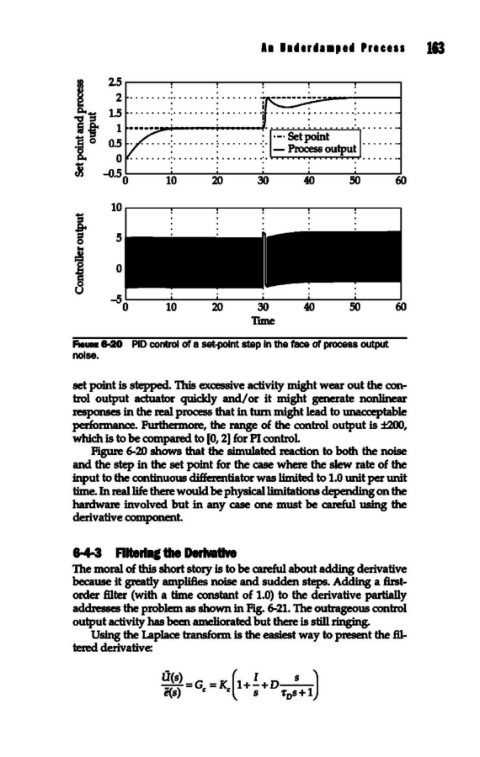
             Aa .. 8-20  PID control of a set-point step In the face of process output
             noise.

             set point is stepped. This excessive activity might wear out the con-
             trol  output  actuator  quickly  and/ or it might  generate  nonlinear
             responses in the real process that in tum might lead to unacceptable
             performance. Furthermore, the range of the control output is ±200,
             which is to be compared to [0, 2] for PI controL
                Figure 6-20 shows that the simulated reaction to both the noise
             and the step in the set point for the case where the slew rate of the
             input to the continuous differentiator was limited to 1.0 unit per unit
             time. In real life there would be physical limitations depending on the
             hardware involved but in any case one must be careful using the
             derivative component.


             8-4-3  RlterlnJ tile Derivative
             The moral of this short story is to be careful about adding derivative
             because it greatly amplifies noise and sudden steps. Adding a first-
             Older filter (with a time constant of 1.0) to the derivative partially
             addresses the problem as shown in Fig. 6-21. The outrageous control
             output activity has been ameliorated but there is still ringing.
                Using the Laplace transform is the easiest way to present the fil-
             tered derivative:

                            U(s)       (   I      s   )
                            _() =Gc: =Kc:  1+-+D--
                            e s            s   -r s+  1
                                                0

