


Page 186 - Practical Control Engineering a Guide for Engineers, Managers, and Practitioners
P. 186
An  Underdamped  Process    161


             6-4-1  Complete Cancellation
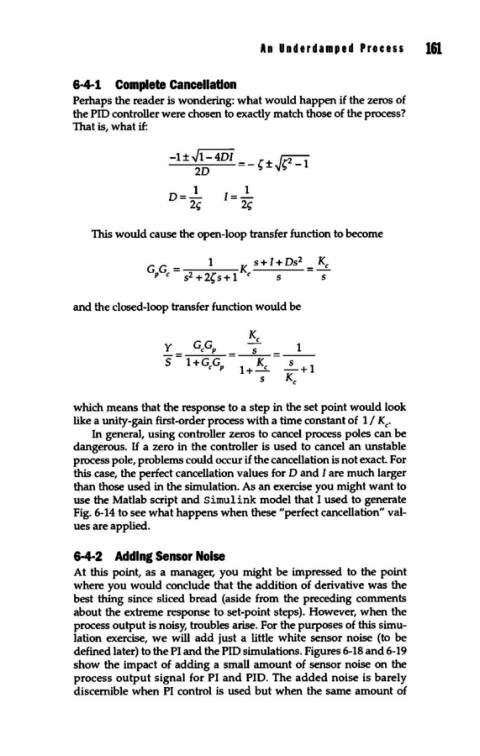
             Perhaps the reader is wondering: what would happen if  the zeros of
             the PID controller were chosen to exactly match those of the process?
             That is, what if:
                             -1±~  =-{±~{2-1


                                 1        1
                             D=-      I=-
                                 2~      2~

                This would cause the open-loop transfer function to become

                                                  2
                         G G  =     1    K  s +I+ Ds  Kc
                                2
                           P  c   s +  2{  s +  1  c   s   s
             and the closed-loop transfer function would be

                                          Kc
                                           s   -  1
                                        --K-- s  +
                                         1+-c       1
                                            S   Kc

             which means that the response to a step in the set point would look
             like a unity-gain first-order process with a time constant of 1 I Kc.
                In general, using controller zeros to cancel process poles can be
             dangerous. If a zero in the controller is used to cancel an unstable
             process pole, problems could occur if  the cancellation is not exact. For
             this case, the perfect cancellation values for D and I are much larger
             than those used in the simulation. As an exercise you might want to
             use the Matlab script and simulink model that I used to generate
             Fig. 6-14 to see what happens when these "perfect cancellation" val-
             ues are applied.

             6-4-2  Adding Sensor Noise
             At this point, as a  manager,  you might be impressed to the point
             where you would conclude that the addition of derivative was the
             best thing since sliced bread (aside from  the preceding comments
             about the extreme response to set-point steps). However, when the
             process output is noisy, troubles arise. For the purposes of this simu-
             lation exercise,  we will  add just a  little  white sensor noise  (to  be
             defined later) to the PI and the PID simulations. Figures 6-18 and 6-19
             show the impact of adding a  small amount of sensor noise on the
             process output signal for PI and PID. The added noise is barely
             discernible when PI control is used but when the same amount of

