


Page 190 - Practical Control Engineering a Guide for Engineers, Managers, and Practitioners
P. 190
An  Underdamped  Process    165


                                                                 .. ·
                                                              .. : :· ..
              &i   60
              :2-
               QJ   40
              "'0                                 · .. ·
               .a                               .. ··.
               ·~  20                     f.   ·:···.  :.   •  •• '   •• •  ,
               ns                    . -.......  ::;_,,:.:~-·- ·-:-·-· ~ ·-·-:-·- ..... -·:.
              :E   0  ,


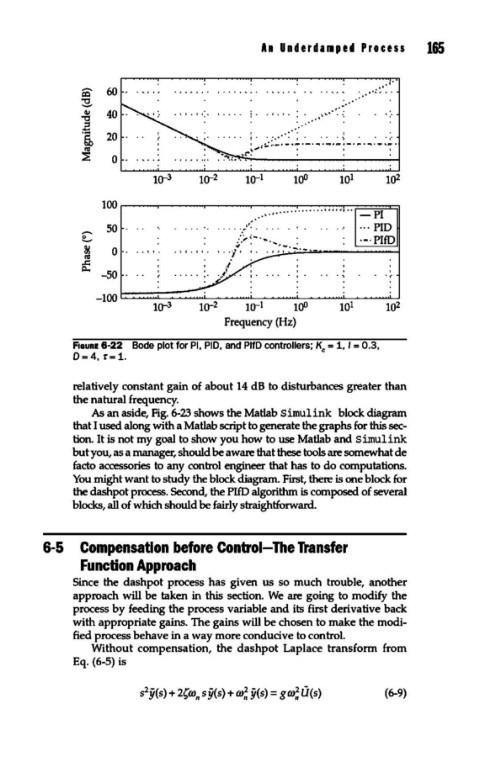
             F1auRE 6-22  Bode plot for PI, PI D.  and PlfD controllers; Kc = 1, I= 0.3,
             0=4, T=1.


             relatively constant gain of about 14 dB to disturbances greater than
             the natural frequency.
                As an aside, Fig. 6-23 shows the Matlab simulink  block diagram
             that I used along with a Matlab script to generate the graphs for this sec-
             tion. It is not my goal to show you how to use Matlab and simulink
             but you, as a manager, should be aware that these tools are somewhat de
             facto accessories to any control engineer that has to do computations.
             You might want to study the block diagram. First, there is one block for
             the dashpot process. Second, the PlfD algorithm is composed of several
             blocks, all of which should be fairly straightforward.


        6-5  Compensation before Control-The Transfer
              Function Approach
             Since  the  dashpot process has given  us so much trouble,  another
             approach will be taken in this section. We  are going to modify the
             process by feeding the process variable and its first derivative back
             with appropriate gains. The gains will be chosen to make the modi-
             fied process behave in a way more conducive to control.
                Without compensation,  the dashpot Laplace  transform  from
             Eq. (6-5) is

                                                                 (6-9)

