


Page 196 - Practical Control Engineering a Guide for Engineers, Managers, and Practitioners
P. 196
170   Chapter  Six


             which can be solved for KY,  KY,,  and Ku as in


                                                                (6-14)


                This completes the construction of the modified process. There is
             one  nontrivial  problem  remaining-how  does  one  get  values  of
             dy  / dx or y' so it can be fed back? For the time being we will assume
             that y' is available by some means. In  Chap. 10, the Kalman filter will
             be shown as one means of obtaining estimates of y and y' or, in gen-
             eral, the state of the process, especially in a noisy atmosphere. Alter-
             natively, we might try generating  dy I dt  or  y'  by using a filtered
             differentiator in a manner similar to what was used in generating the
             PID single in the Sec. 6-4.
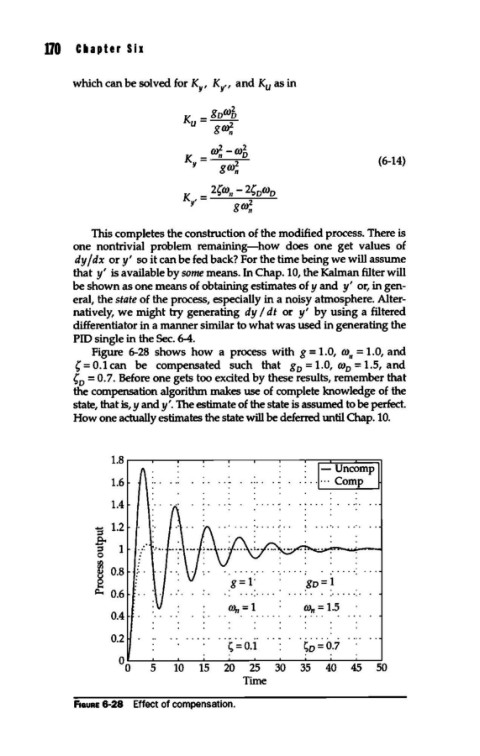
                Figure  6-28  shows  how  a  process  with  g =  1.0, co,= 1.0, and
             {  =  0.1 can  be  compensated  such  that  g =  1.0, co =  1.5, and
                                                  0       0
             { =  0.7. Before one gets too excited by these results, remember that
              0
             the compensation algorithm makes use of complete knowledge of the
             state, that is, y andy'. The estimate of the state is assumed to be perfect.
             How one actually estimates the state will  be deferred until Chap. 10.


                   1.8 r----r---r--~-~----.-..,....-----,.----r:=:::::t:;:;:==:J=::::;,

                   1.6
                   1.4
                 ::s  1.2
                 t   1
                 0
                 Ia                                     .....
                 (U  0.8
                 e                     g=1:         .Ko=~
                 Q...  0.6         . .           .....
                                       co,= 1      co,= 1.5
                   0.4             \.      . .....
                   0.2               ......   "    . .....
                                       ~=0.1       ~o=0.7
                     00   5   10   15   20   25   30   35   40   45   50
                                         Time

             F1auRE 6-28  Effect of compensation.

