


Page 177 - Practical Control Engineering a Guide for Engineers, Managers, and Practitioners
P. 177
152  Chapter  Six


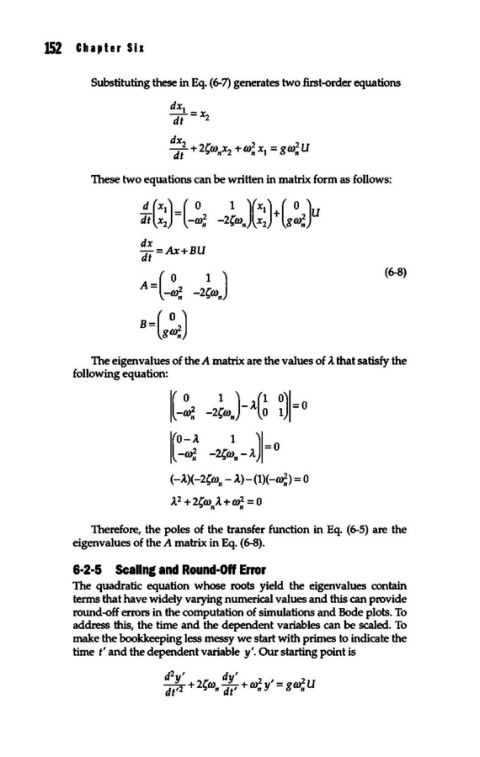
                Substituting these in Eq. (6-7) generates two first-order equations
                             dx  1
                             dt=x2
                             dx2           2   _   2
                             Tt + 2{conx2 +con x1  - gco,. u

                These two equations can be written in matrix form as follows:


                                                                 (6-8)
                        A-(  0     1  )
                          - -co;  -2{con


                The eigenvalues of the A matrix are the values of A. that satisfy the
             following equation:

                               0  1 ) ;t(1  0)1-0
                             I(  -co;  -2{co,.  -  0  1  -

                             I(~ -~.-!JI=O


                             (-A.)(-2{co,- A.)-(1)(-co;) = 0

                             Jt2 + 2{co,.A.+to; = 0
                Therefore, the poles of the transfer function in Eq.  (6-5) are the
             eigenvalues of the A matrix in Eq. ( 6-8).
             6·2·5  Scaling and Round-Off Error
             The quadratic equation  whose  roots  yield  the eigenvalues  contain
             terms that have widely varying numerical values and this can provide
             round-off errors in the computation of simulations and Bode plots. To
             address this, the time and the dependent variables can be scaled. To
             make the bookkeeping less messy we start with primes to indicate the
             time t' and the dependent variable y'. Our starting point is

                            d2yl      dy'   2   I  -  2
                            dt'2  + 2{con tit'+ cony  - gco, u

