


Page 166 - Practical Control Engineering a Guide for Engineers, Managers, and Practitioners
P. 166
Matrices  and  Higher-Order  Process  Models   141


             the single-tank process. The next curve on the right is for N = 2 and
             the response reaches a value of 0.63 at about t = 2.  Note that as N
             increases the response curves take on a sharper inflection and the
             time at which the process output passes the value of 0.63 increases.
             For large N, the process appears to have a significant dead time even
             though there is no explicit dead time in the model.
                Now, repeat this thought experiment except make the time con-
             stant of each tank decrease as N increases such that the total effective
             time constant is held constant at 1.0, for each N.


                               dx.
                                 1
                             T--+x. =x.      i = 1,  ...  ,N
                              I  df   I   1- 1
                                 1
                             T-=-
                              1   N

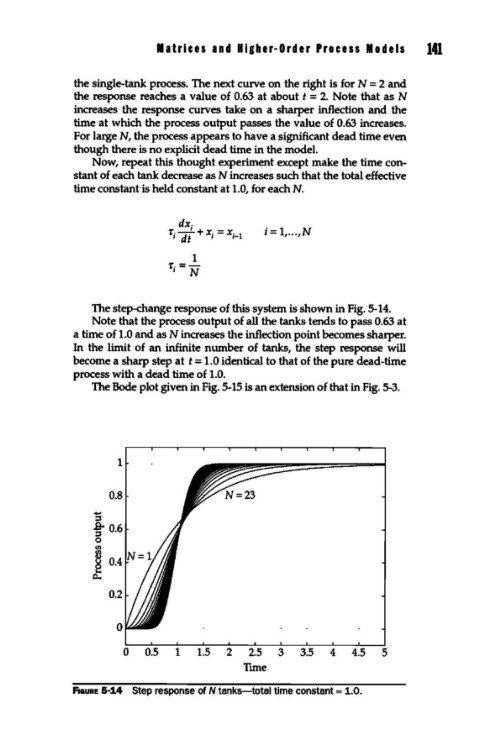
                The step-change response of this system is shown in Fig. 5-14.
                Note that the process output of all the tanks tends to pass 0.63 at
             a time of 1.0 and as N increases the inflection point becomes sharper.
             In the limit of an infinite number of tanks, the step response will
             become a sharp step at t =  1.0 identical to that of the pure dead-time
             process with a dead time of 1.0.
                The Bode plot given in Fig. 5-15 is an extension of that in Fig. 5-3.


                    1

                   0.8
                .....
                 =
                t 0.6
                 <I)
                 ~
                 2  o.4
                Q..,
                   0.2


                    0
                     0   0.5   1   1.5   2   2.5   3   3.5   4   4.5   5
                                         Tune
             F1auRE 5-14  Step response of N tanks-total time constant= 1.0.

