


Page 137 - Pressure Vessel Design Manual
P. 137
Design of Vessel Supports   117

              is ‘/2 mv where  m =mass  of air, 0.0765 PCF, and v is
              the  acceleration  due  to  gravity, 32.2 ft/sec.  The  mass
              density of the air will vary as function of  altitude, lati-
              tude,  temperature,  weather,  or  season.  This  constant
              may be vaned  to  suit the actual conditions if they are
              known with certainty.  See ASCE 7-95.
           4.  Short, vertical vessels, vessels in structures, or horizon-
              tal  vessels  where  the  height  is  divided between  two
              pressure  zones  may  be  more  conveniently  designed
              by  applying  the  higher  pressure  uniformly  over  the
              entire vessel.
           5. Vessels  that  qualify as “flexible” may  or may  not  be
              required  to  be  checked  for  dynamic  response.  This
              could  include  a dynamic analysis, which is a check  of
              elastic  instability, or  a vibration  analysis for vibration
              amplification  due to vortex  shedding.  See procedure
              4-8 “Vibration of  Tall  Towers  and  Stacks,” for  addi-
              tional information.
           6.  Deflection  due to wind  should  be  limited to 6in. per
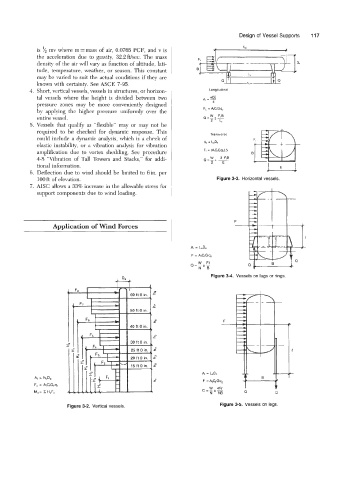
              100 ft of elevation.                                                3-3.  Horizontal vessels.
           7. AISC allows a 33% increase in the allowable stress for
              support components due to wind loading.


                                                                                   -
                                                                                   F
                   Application of Wind Forces


                                                                    At  = L,D,
                                                                    F = AiCfGq,
                                                                      W   Ft‘
                                                                    Q=-*-
                                                                      N-8
                                                                           Figure 3-4.  Vessels on lugs or rings.


                                                                               F


                                                                        A, = We

                                                                          W  4FP
                                                                        o=-*-
                                                                          N   NB      0          Q
                        Figure 3-2. Vertical vessels.                         Figure 3-5.  Vessels on legs.

