


Page 138 - Pressure Vessel Design Manual
P. 138
118    Pressure Vessel Design Manual
                                                   PROCEDURE 3-2

                                         WIND DESIGN PER UBC-97


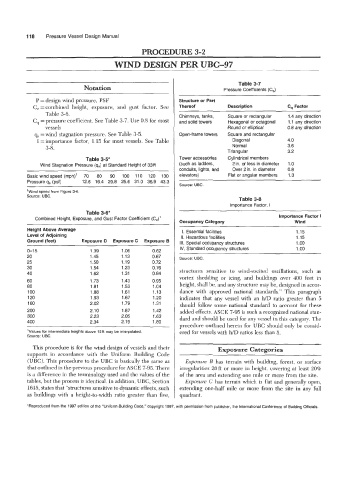
                                                                                     Table 3-7
                               Notation                                         Pressure Coefficients (C,)
             P =design  wind pressure, PSF                      Structure or Part
             C,  =combined  height,  exposure,  and  gust  factor.  See   Thereof   Description       C,  Factor
                 Table 3-6.                                     Chimneys, tanks,   Square or rectangular   1.4 any direction
            C,  =pressure coefficient. See Table 3-7. Use 0.8 for most   and solid towers   Hexagonal or octagonal   1.1 any direction
                 vessels                                                         Round or elliptical   0.8 any direction
             q, =wind  stagnation pressure.  See Table 3-5.     Open-frame towers   Square and rectangular
              I =importance  factor,  1.15 for most vessels. See Table             Diagonal           4.0
                                                                                   Normal
                 3-8.                                                            Triangular           3.6
                                                                                                      3.2
                               Table 3-5*                       Tower accessories   Cylindrical members
               Wind Stagnation Pressure (q,)  at Standard Height of 33ft   (such as ladders,   2 in. or less in diameter   1  .o
                                                                conduits, lights, and   Over 2 in. in diameter   0.8
          Basic wind speed (mph)'   70   80   90   100  110  120  130   elevators)   Flat or angular members   1.3
           Pressure q,  (psf)   12.6  16.4  20.8  25.6  31.0  36.9  43.3
                                                                Source: UBC.
           'Wind  speed from Figure 3-6.
           Source: UBC.                                                              Table 3-8
                                                                                  Importance Factor, I
                               Table 3-6*                                                          Importance Factor I
             Combined Height, Exposure, and Gust Factor Coefficient (Ce)'
                                                                Occupancy Category                       Wind
           Height Above Average                                  1.  Essential facilities                1.15
           Level of Adjoining                                    II.  Hazardous facilities               1.15
           Ground (feet)      Exposure D  Exposure C  Exposure B   Ill. Special occupancy structures     1  .oo
             ~                                                  IV. Standard occupancy structures        1 .oo
           0-1 5                 1.39       1.06       0.62
           20                    1.45       1.13       0.67     Source: UBC.
           25                    1.50       1.19       0.72
           30                    1.54       1.23       0.76     structures  sensitive  to  wind-excited  oscillations,  such  as
           40                    1.62       1.31       0.84     vortex  shedding  or  icing,  and  buildings  over  400  feet  in
           60                    1.73       1.43       0.95     height, shall be, and any structure may be, designed in accor-
           80                    1.81       1.53       1.04
           100                   1.88       1.61       1.13     dance  with  approved  national  standards."  This  paragraph
           120                   1.93       1.67       1.20     indicates  that  any vessel  with  an WD  ratio  greater  than  5
           160                   2.02       1.79       1.31     should  follow some national  standard  to account  for these
           200                   2.10       1.87       1.42     added effects. ASCE 7-95 is such a recognized national stan-
           300                   2.23       2.05       1.63     dard and should be used for any vessel in this category. The
           400                   2.34       2.19       1 .80
                                                                procedure outlined herein  for UBC  should only be consid-
           'Values for intermediate heights above 15ft may be interpolated.   ered for vessels with h/D ratios less than 5.
           Source: UBC.

             This procedure is for the wind design of vessels and their       Exposure Categories
           supports  in  accordance  with  the  Uniform  Building  Code
           (UBC). This procedure to the UBC is basically the same as   Exposure  B  has  terrain  with  building,  forest,  or  surface
           that outlined in the previous procedure for AXE 7-95. There   irregularities  20ft or more  in height, covering at least 20%
           is a difference in the terminology used and the values of the   of the area and extending one mile or more from the site.
           tables, but the process is identical. In addition, UBC, Section   Exposure C  has terrain  which is flat and generally open,
           1615, states that "structures sensitive to dynamic effects, such   extending one-half  mile  or  more  from  the  site in  any full
           as buildings  with  a height-to-width  ratio greater  than  five,   quadrant.

           'Reproduced from the 1997 edition of the "Uniform Building Code," copyright 1997, with permission from publisher, the International Conference of Building Officials.

