


Page 188 - Pressure Vessel Design Manual
P. 188
166    Pressure Vessel Design Manual
                                                 PROCEDURE 3-10

            DESIGN OF HORIZONTALVESSEL ON SADDLES [I, 3, 5, 14, 151


                                                                       S = allowable stress, tension, psi
               ~
                             Notation                                 S, =allowable  stress, compression, psi
                                                                    S1-14  = shell, head, and ring stresses, psi
                A, = cross-sectional area of  composite  ring stiffen-   K1-9  = coefficients
                    er, in.  2                                       FL = longitudinal force due to wind, seismic, expan-
                Af = projected  area of vessel, ft2                       sion, contraction, etc., lb
                 E =joint  efficiency                                 FT =transverse  force, wind or seismic, lb
                El = modulus of elasticity, psi                       ax = longitudinal stress, internal pressure, psi
                Ch = seismic factor (see Procedure 3-3)               c+ = circumferential stress, internal pressure, psi
                Cf = shapefactor  = 0.8                               a,, = longitudinal stress, external pressure, psi
                 q,  =wind  pressure,  psf                            as = circumferential stress in stiffening ring, psi
                De = effective vessel diameter, ft                    ah = latitudinal stress in head due to internal pres-
                 I~ = moment of inertia of  ring stiffener, in.4          sure, psi
                 t,  = thickness of wear plate, in.                   F,  = minimum yield stress, shell, psi
                 t, =thickness  of shell, in.                          P = internal pressure,  psi
                 th =thickness  of head, in.                          P,, = external pressure, psi
                 Q =total  load per  saddle (including piping  loads,   G = gust factor, wind
                     wind or seismic reactions, platforms, operating   K,  =velocity  pressure  coefficient
                     liquid, etc.) lb                                  I =importance  factor,  1.el.25 for vessels
                W,  = operating weight of vessel, lb                   V =basic wind speed, mph
                MI = longitudinal bending moment at saddles, in.-lb   K, = pier spring rate, 46 k.
                M2 = longitudinal  bending  moment  at  midspan,       ~.l. = friction coefficient
                     in.  -1b                                          y =pier  deflection, in.


                                                                                      R,   E mean radius, in.
                                                                                      R
                                                                                    ,-  = radius, ft


                                                    l'  = 1.56 fi


                                                         Stiffening
                                                           ring
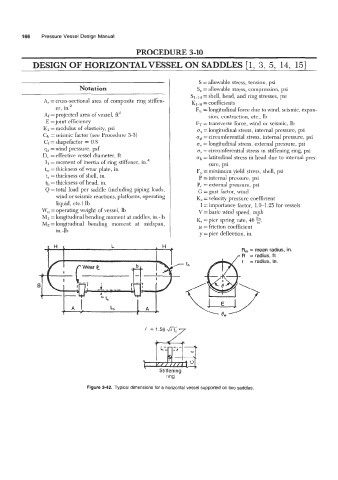
                                Figure 3-42.  Typical dimensions for a horizontal vessel supported on two saddles.

