


Page 244 - Pressure Vessel Design Manual
P. 244
222    Pressure Vessel Design Manual
                                                  PROCEDURE 4-5

                                   DESIGN OF RING GIRDERS [8-121


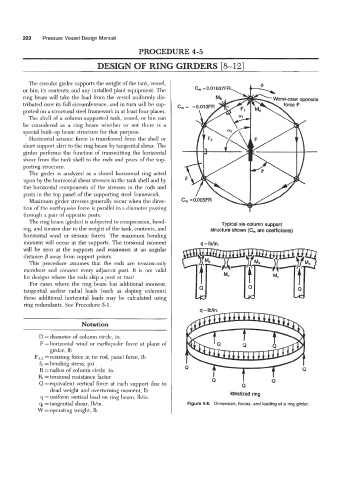
           The circular girder supports the weight of the tank, vessel,
         or bin; its contents; and any installed plant equipment. The
         ring beam will take the load from the vessel uniformly dis-
         tributed over its full circumference, and in turn will be sup-
         ported on a structural steel framework in at least four places.
           The shell of a column-supported  tank, vessel, or bin can
         be  considered  as  a  ring  beam  whether  or  not  there  is  a
         special built-up beam structure for that purpose.
           Horizontal  seismic force is transferred  from  the  shell or
         short support skirt to the ring beam by tangential shear. The
         girder performs  the function  of  transmitting the horizontal
         shear from the tank shell to the rods and posts  of  the sup-
         porting structure.
           The  girder  is  analyzed  as a closed  horizontal  ring  acted
         upon by the horizontal shear stresses in the tank shell and by
         the horizontal  components  of  the stresses in  the  rods  and
         posts in the top panel of the supporting steel framework.
           Maximum girder stresses generally occur when the direc-
         tion of the earthquake force is parallel to a diameter passing
         through  a pair of opposite posts.
           The ring beam (girder) is subjected to compression, bend-           Typical six-column support
         ing, and torsion due to the weight of the tank, contents, and     structure shown (C,  are coefficients)
         horizontal  wind  or seismic  forces.  The maximum  bending
         moment will occur  at the supports.  The torsional  moment    q - Iblin.
         will  be  zero  at the  supports  and  maximum  at  an  angular
         distance  away from support points.
           This  procedure  assumes  that  the  rods  are  tension-only
         members  and  connect  every  adjacent  post.  It is  not  valid
         for designs where the rods skip a post or two!
           For cases where  the  ring  beam  has  additional  moment,
         tangential  and/or  radial  loads  (such  as  sloping  columns)
         these  additional  horizontal  loads  may  be  calculated  using
         ring redundants.  See Procedure 5-1.


                            ~
                              Notation
               D = diameter of column circle, in.
               F =horizontal  wind  or  earthquake  force at plane  of
                   girder, lb
             Fl,z = resisting force in tie rod, panel force, lb
               fb =bending  stress, psi
               R = radius of column circle, in.
              R, =torsional  resistance  factor                                       I
               Q = equivalent vertical  force at each  support due to      Q          Q
                   dead weight and overturning moment, Ib
               q = uniform vertical load on ring beam, lbhn.                      Idealized ring
               qt =tangential  shear, lb/in.                       Figure 4-8.  Dimension, forces, and loading at a ring girder.
              W = operating weight, Ib

