


Page 220 - Psychological Management of Individual Performance
P. 220
204                       the high performance cycle: standing the test of time
                                             Moderators
                                             Ability
                                             Commitment
                                             Feedback                      Rewards
                                             Task complexity               Non-contingent
                                             Situational constraints       rewards


                                 Demands
                                 Challenge, high
                                 goals on                Performance  Contingent
                                 meaningful,             (hard or soft  Rewards    Satisfaction
                                 growth-facilitating     measures)    (internal,
                                 tasks or series of                   external)
                                 tasks plus high
                                 self-efficacy


                                              Mediators
                                              Direction                          Consequences
                                              Effort                             Commitment to
                                              Persistence                        organization and
                                              Task-specific
                                                                                 willingness to
                                              strategies                         accept future
                                                                                 challenges

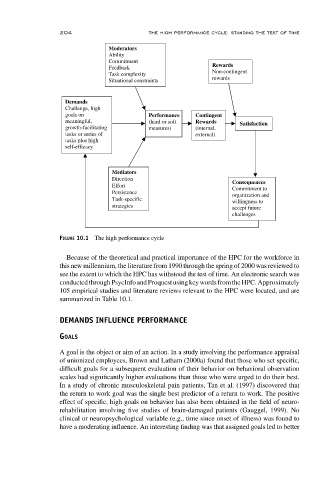
                               FIGURE 10.1 The high performance cycle


                                 Because of the theoretical and practical importance of the HPC for the workforce in
                               this new millennium, the literature from 1990 through the spring of 2000 was reviewed to
                               see the extent to which the HPC has withstood the test of time. An electronic search was
                               conductedthroughPsycInfoandProquestusingkeywordsfromtheHPC.Approximately
                               105 empirical studies and literature reviews relevant to the HPC were located, and are
                               summarized in Table 10.1.


                               DEMANDS INFLUENCE PERFORMANCE

                               GOALS

                               A goal is the object or aim of an action. In a study involving the performance appraisal
                               of unionized employees, Brown and Latham (2000a) found that those who set specific,
                               difficult goals for a subsequent evaluation of their behavior on behavioral observation
                               scales had significantly higher evaluations than those who were urged to do their best.
                               In a study of chronic musculoskeletal pain patients, Tan et al. (1997) discovered that
                               the return to work goal was the single best predictor of a return to work. The positive
                               effect of specific, high goals on behavior has also been obtained in the field of neuro-
                               rehabilitation involving five studies of brain-damaged patients (Gauggel, 1999). No
                               clinical or neuropsychological variable (e.g., time since onset of illness) was found to
                               have a moderating influence. An interesting finding was that assigned goals led to better

