


Page 511 - Refining Biomass Residues for Sustainable Energy and Bioproducts
P. 511
Blue biotechnology: a vision for future marine biorefineries      467


           produced during the process. Fertilizers or pesticides are not needed to cultivate the
           marine macroalgae. The biological conversion of Ulva feedstock to simple sugars is
           costly; however, in the near future, process costs could be reduced using modern
           molecular engineering and synthetic biology.
              Grand View Research, Inc. reported that the global algae biofuel market
           increased due to the fossil fuel reserves depletion and environmental pollution, fur-
           ther; by 2025 the algal biofuel market is expected to reach 10.73 billion USD.
           Biofuel yield from algae is 2 20 times higher than corn feedstock based biofuel.
           The limiting factors for marine algae industry growth are technological challenges,
           various regions, and climate can change the consistency of algae biomass cultiva-
           tion and high capital investment. In the future, this moves the biofuel into product
           commercialization. In the transportation sector, algae biofuel will replace the con-
           ventional fuels due to its high potential and demand for algae biofuel will increase
           by 70% in 2025. Some of the major players in the algae biofuel industries are
           Reliance Life Sciences, Algenol, Blue Marble Production, Solazyme Inc., Sapphire
           Energy, Culture Biosystems, Origin Oils Inc., Proviron, Genifuels, Algae Systems,
           Solix Biofuels, and Algae Production Systems.


           21.5    Potential of blue biotechnology

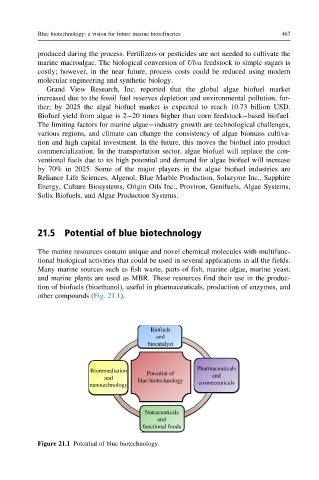
           The marine resources contain unique and novel chemical molecules with multifunc-
           tional biological activities that could be used in several applications in all the fields.
           Many marine sources such as fish waste, parts of fish, marine algae, marine yeast,
           and marine plants are used as MBR. These resources find their use in the produc-
           tion of biofuels (bioethanol), useful in pharmaceuticals, production of enzymes, and
           other compounds (Fig. 21.1).


                                          Biofuels
                                           and
                                         biocatalyst


                         Bioremediation  Potential of  Pharmaceuticals
                             and                          and
                                      blue biotechnology
                         nanotechnology                cosmeceuticals


                                        Nutraceuticals
                                            and
                                       functional foods
           Figure 21.1 Potential of blue biotechnology.

