


Page 515 - Refining Biomass Residues for Sustainable Energy and Bioproducts
P. 515
Blue biotechnology: a vision for future marine biorefineries      471


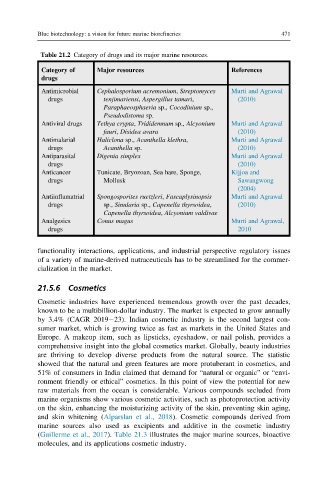
            Table 21.2 Category of drugs and its major marine resources.
            Category of    Major resources                      References
            drugs
            Antimicrobial  Cephalosporium acremonium, Streptomyces  Murti and Agrawal
              drugs          tenjimariensi, Aspergillus tamari,  (2010)
                             Paraphaeosphaeria sp., Cocodinium sp.,
                             Pseudodistoma sp.
            Antiviral drugs  Tethya crypta, Trididemnum sp., Alcyonium  Murti and Agrawal
                             fauri, Disidea avara                (2010)
            Antimalarial   Haliclona sp., Acanthella klethra,   Murti and Agrawal
              drugs          Acanthella sp.                      (2010)
            Antiparasital  Digenia simplex                      Murti and Agrawal
              drugs                                              (2010)
            Anticancer     Tunicate, Bryozoan, Sea hare, Sponge,  Kijjoa and
              drugs          Mollusk                             Sawangwong
                                                                 (2004)
            Antiinflamatrial  Spongosporites ruetzleri, Fascaplysinopsis  Murti and Agrawal
              drugs          sp., Sinularia sp., Capenella thyrsoidea,  (2010)
                             Capenella thyrsoidea, Alcyonium valdivae
            Analgesics     Conus magus                          Murti and Agrawal,
              drugs                                              2010


           functionality interactions, applications, and industrial perspective regulatory issues
           of a variety of marine-derived nutraceuticals has to be streamlined for the commer-
           cialization in the market.

           21.5.6 Cosmetics
           Cosmetic industries have experienced tremendous growth over the past decades,
           known to be a multibillion-dollar industry. The market is expected to grow annually
           by 3.4% (CAGR 2019 23). Indian cosmetic industry is the second largest con-
           sumer market, which is growing twice as fast as markets in the United States and
           Europe. A makeup item, such as lipsticks, eyeshadow, or nail polish, provides a
           comprehensive insight into the global cosmetics market. Globally, beauty industries
           are thriving to develop diverse products from the natural source. The statistic
           showed that the natural and green features are more protuberant in cosmetics, and
           51% of consumers in India claimed that demand for “natural or organic” or “envi-
           ronment friendly or ethical” cosmetics. In this point of view the potential for new
           raw materials from the ocean is considerable. Various compounds secluded from
           marine organisms show various cosmetic activities, such as photoprotection activity
           on the skin, enhancing the moisturizing activity of the skin, preventing skin aging,
           and skin whitening (Alparslan et al., 2018). Cosmetic compounds derived from
           marine sources also used as excipients and additive in the cosmetic industry
           (Guillerme et al., 2017). Table 21.3 illustrates the major marine sources, bioactive
           molecules, and its applications cosmetic industry.

