


Page 134 -
P. 134
120    CHAPTER 5  Surveys


                            In that revision, the respondents could simply say, “none” but the question also in-
                         vites the respondents to think carefully about the problems that they might have faced.

                         5.6.2   CLOSED-ENDED QUESTIONS

                         There are two types of closed-ended questions. One type has ordered response cate-
                         gories, and the other type does not. An ordered response is when a number of choices
                         can be given, which have some logical order (Dillman, 2000). For instance, using a
                         scale such as “excellent to poor” or “strongly agree to strongly disagree” would be
                         an ordered response. Likert scale questions, which often take the form of a scale of
                         1 to 5, 7, or 9, ask users to note where they fall on a scale of, for example, “strongly
                         agree” to “strongly disagree.” Typically, closed-ended questions with an ordered re-
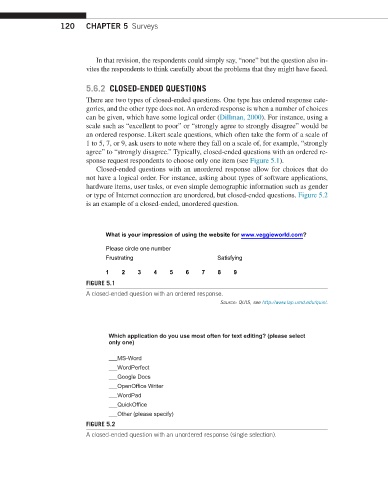
                         sponse request respondents to choose only one item (see Figure 5.1).
                            Closed-ended questions with an unordered response allow for choices that do
                         not have a logical order. For instance, asking about types of software applications,
                         hardware items, user tasks, or even simple demographic information such as gender
                         or type of Internet connection are unordered, but closed-ended questions. Figure 5.2
                         is an example of a closed-ended, unordered question.


                              What is your impression of using the website for www.veggieworld.com?
                              Please circle one number
                              Frustrating                     Satisfying

                              1    2   3    4   5    6   7    8   9
                         FIGURE 5.1
                         A closed-ended question with an ordered response.
                                                              Source: QUIS, see http://www.lap.umd.edu/quis/.


                               Which application do you use most often for text editing? (please select
                               only one)

                               ___MS-Word
                               ___WordPerfect
                               ___Google Docs
                               ___OpenOffice Writer
                               ___WordPad
                               ___QuickOffice
                               ___Other (please specify)
                         FIGURE 5.2
                         A closed-ended question with an unordered response (single selection).

