


Page 135 -
P. 135
5.6  Developing survey questions  121


                       When using my primary computer, I use the following input devices or methods
                       on a daily basis (select as many as apply)
                       ____Keyboard

                       ____  Mouse

                       ____Touchpad


                       ____Trackball

                       ____Voice recognition


                       ___Multitouch screen


                       ___Eye-tracking
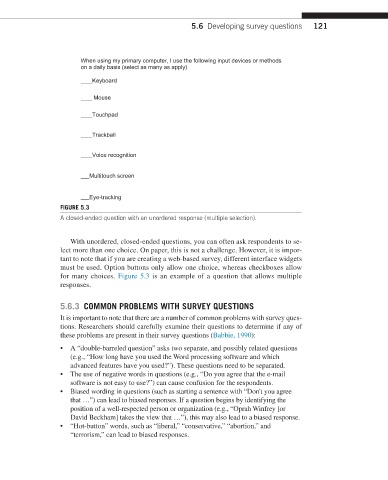
                  FIGURE 5.3
                  A closed-ended question with an unordered response (multiple selection).


                     With unordered, closed-ended questions, you can often ask respondents to se-
                  lect more than one choice. On paper, this is not a challenge. However, it is impor-
                  tant to note that if you are creating a web-based survey, different interface widgets
                  must be used. Option buttons only allow one choice, whereas checkboxes allow
                  for many choices. Figure 5.3 is an example of a question that allows multiple
                  responses.

                  5.6.3   COMMON PROBLEMS WITH SURVEY QUESTIONS
                  It is important to note that there are a number of common problems with survey ques-
                  tions. Researchers should carefully examine their questions to determine if any of
                  these problems are present in their survey questions (Babbie, 1990):

                  •  A “double-barreled question” asks two separate, and possibly related questions
                     (e.g., “How long have you used the Word processing software and which
                     advanced features have you used?”). These questions need to be separated.
                  •  The use of negative words in questions (e.g., “Do you agree that the e-mail
                     software is not easy to use?”) can cause confusion for the respondents.
                  •  Biased wording in questions (such as starting a sentence with “Don't you agree
                     that …”) can lead to biased responses. If a question begins by identifying the
                     position of a well-respected person or organization (e.g., “Oprah Winfrey [or
                     David Beckham] takes the view that …”), this may also lead to a biased response.
                  •  “Hot-button” words, such as “liberal,” “conservative,” “abortion,” and
                     “terrorism,” can lead to biased responses.

