


Page 360 - Reservoir Formation Damage
P. 360
340   Reservoir Formation Damage

                Mineral  stability  charts  can  be  more  meaningfully  developed  by  con-
                sidering  the  incongruent  equilibrium  reactions  of  various  solid  phases
                including  the  igneous  and  metamorphic  reactions  (Schneider,  1997).
                  Incongruent  reactions  represent  the  direct  relationships  of  the  various
                solid  minerals  involved  in  aqueous  solution  systems.  The  expressions  of
                the  incongruent reactions  are  derived  from  a combination  of  the  relevant
                mineral  dissolution/precipitation  reactions  in a manner to conserve  certain
                key  elements  of  the  solid  minerals  so  that  the  aqueous  ionic  species  of
                these elements do not explicitly  appear in the final  equation.  For  example,
                the incongruent reactions  of the  alumino  silicate  minerals, including clay
                minerals,  feldspars,  and  chlorites,  are  usually  expressed  to  conserve  the
                aluminum  element  (Fletcher,  1993;  Schneider,  1997).  Aluminum  is  a
                natural  choice  as  the  conserved  element  because  this  element  is  mostly
                immobile  and  the  activities  of the  aqueous aluminum species  are relatively
                low  (Hayes  and  Boles,  1992;  Schneider,  1997).  Consequently,  the incon-
                gruent  mineral  reaction  equations  do  not  involve  the  potential  dissolved
                                                +
                                        3
                aluminum  species  such as Af , Al(OH) 2 ,  Al(OH) 4~,  Al(OH)  +2 ,  and  Al(OH) 3°
                (Schneider,  1997).  Thus,  the  aluminum  element  conserving  incongruent
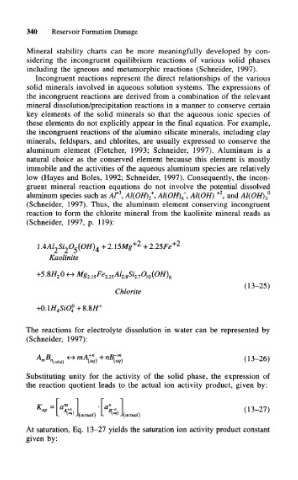
                reaction  to  form  the  chlorite  mineral  from  the  kaolinite  mineral  reads  as
                (Schneider,  1997,  p.  119):


                                    + 2A5Mg +2  + 2.25Fe +2
                   L4Al 2Si 2O 5(OH) 4
                      Kaolinite
                  +5.8//0 <-»
                                                                          (13-25)
                                       Chlorite

                  +0.1/f 4S*0 4°+8.8// +

                The  reactions  for  electrolyte  dissolution  in  water  can  be  represented  by
                (Schneider,  1997):

                  AB       <->m^   +ne                                    (13-26)
                                w      w
                Substituting  unity  for  the  activity  of  the  solid  phase,  the  expression  of
                the  reaction  quotient  leads  to  the  actual  ion  activity  product,  given  by:


                                                                          (13-27)
                              (actual)    (actual)
                At  saturation, Eq.  13-27  yields  the  saturation ion  activity product  constant
                given  by:

