


Page 364 - Reservoir Formation Damage
P. 364
344    Reservoir Formation Damage

                the  reaction  and  the  slopes  of  the  stability  boundaries  are  temperature
                dependent  (Schneider,  1997).
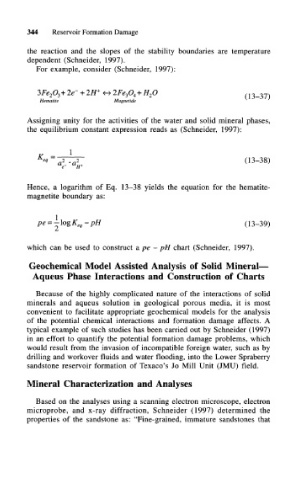
                   For  example,  consider  (Schneider,  1997):


                         + 2e~ + 2H +          H 2O
                   Hematite            Magnetide                          (13-37)

                Assigning  unity  for  the  activities  of  the  water  and  solid  mineral  phases,
                the  equilibrium constant  expression  reads  as  (Schneider,  1997):


                           1
                                                                          (13-38)


                Hence,  a  logarithm  of  Eq.  13-38 yields  the  equation  for  the  hematite-
                magnetite  boundary  as:


                      = -logK eq-pH                                       (13-39)


                which  can be used  to  construct a pe  -  pH  chart  (Schneider,  1997).

                 Geochemical    Model  Assisted  Analysis  of  Solid  Mineral—
                  Aqueus   Phase  Interactions  and   Construction   of  Charts

                  Because  of  the  highly  complicated  nature  of  the  interactions  of  solid
                minerals  and  aqueus  solution  in  geological  porous  media,  it  is  most
                convenient  to  facilitate  appropriate  geochemical  models  for  the  analysis
                of  the  potential  chemical  interactions  and  formation  damage  affects.  A
                typical  example  of  such  studies  has  been  carried  out  by  Schneider  (1997)
                in  an  effort  to  quantify  the  potential  formation damage  problems, which
                would  result from  the  invasion of  incompatible foreign water,  such as by
                drilling  and workover  fluids and water  flooding,  into  the  Lower  Spraberry
                sandstone  reservoir  formation  of  Texaco's  Jo  Mill  Unit  (JMU)  field.

                Mineral   Characterization    and Analyses

                  Based  on  the  analyses using a  scanning electron  microscope,  electron
                microprobe,  and  x-ray  diffraction,  Schneider  (1997)  determined  the
                properties  of  the  sandstone  as:  "Fine-grained,  immature  sandstones  that

