


Page 185 - Robot Builders Source Book - Gordon McComb
P. 185
Exercises                               173

        from each accelerometer is doubly integrated and amplified. Thereafter, the obtained
        power signal enters the active damper where it generates the force P(t) required for
        damping.
           This latter idea of electrically controlled damping being designed to suit different
        and various mechanical systems (including manipulators) seems to be a very fruitful
        means for increasing accuracy of automatic manufacturing machines. The main advan-
        tage of this idea is the possibility to interact between the mechanics and the control
        electronics or computer. This kind of interaction recently has been given the name
        mechatronics.


        Exercise 4E-1

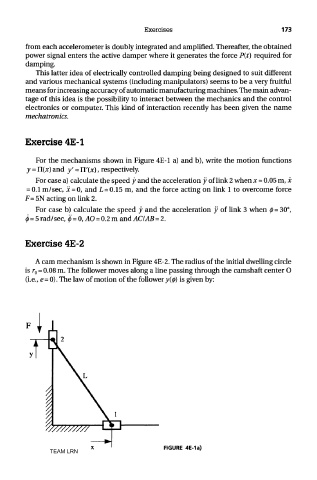
           For the mechanisms shown in Figure 4E-1 a) and b), write the motion functions
                     f
        y = n(.x) and y  = n'(jt), respectively.
           For case a) calculate the speed y and the acceleration y of link 2 when x = 0.05 m, x
        = 0.1 m/sec, x = 0, and L = 0.15 m, and the force acting on link 1 to overcome force
        F= 5N acting on link 2.
           For case b) calculate the speed y and the acceleration y of link 3 when 0 = 30°,
        0 = 5 rad/sec, 0 = 0, AO = 0.2 m and ACIAB = 2.


        Exercise 4E-2

           A cam mechanism is shown in Figure 4E-2. The radius of the initial dwelling circle
        is r 0 = 0.08 m. The follower moves along a line passing through the camshaft center O
        (i.e., e = 0). The law of motion of the follower y(0) is given by:


               TEAM LRN                         FIGURE 4E-1a)

