


Page 264 - Robot Builders Source Book - Gordon McComb
P. 264
252                      Feeding and Orientation Devices

           • Motion is due to inertia; therefore, there is less risk of damage to the parts.
           • Constant and uniform speed of the parts is convenient for orientation (see next
              section).
           • These devices are relatively simple, having no rotating links, and seizure of parts
              is less possible.
           • The feeding speed can be easily tuned and controlled.
           The vibrofeeder can be oscillated by an electromagnet (as mentioned above), pneu-
        modrive, or mechanical means. Usually driving is done by a force field (electromag-
        netic or inertial); only the mechanical drive can function kinematically, thus ensuring
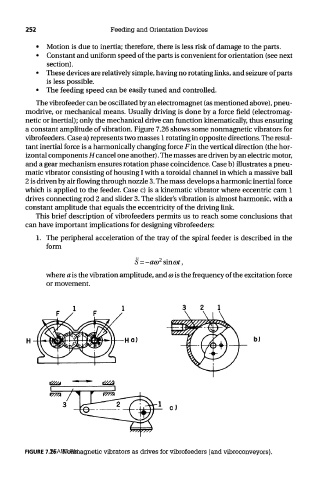
        a constant amplitude of vibration. Figure 7.26 shows some nonmagnetic vibrators for
        vibrofeeders. Case a) represents two masses 1 rotating in opposite directions. The resul-
        tant inertial force is a harmonically changing force Fin the vertical direction (the hor-
        izontal components Hcancel one another). The masses are driven by an electric motor,
        and a gear mechanism ensures rotation phase coincidence. Case b) illustrates a pneu-
        matic vibrator consisting of housing I with a toroidal channel in which a massive ball
        2 is driven by air flowing through nozzle 3. The mass develops a harmonic inertial force
        which is applied to the feeder. Case c) is a kinematic vibrator where eccentric cam 1
        drives connecting rod 2 and slider 3. The slider's vibration is almost harmonic, with a
        constant amplitude that equals the eccentricity of the driving link.
           This brief description of vibrofeeders permits us to reach some conclusions that
        can have important implications for designing vibrofeeders:
           1. The peripheral acceleration of the tray of the spiral feeder is described in the
              form


              where a is the vibration amplitude, and CD is the frequency of the excitation force
              or movement.


               TEAM LRN
        FIGURE 7.26 Nonmagnetic vibrators as drives for vibrofeeders (and vibroconveyors).

