


Page 53 - Robot Builders Source Book - Gordon McComb
P. 53
42                           Concepts and Layouts


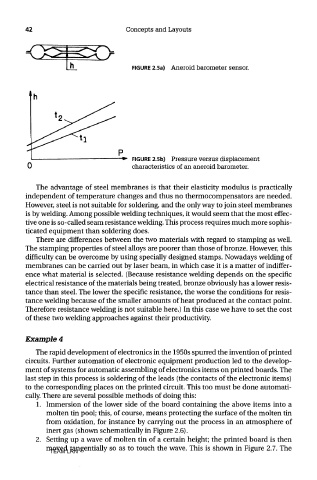
                                       FIGURE 2.5a) Aneroid barometer sensor.


         ' h


                                   P
          i               —         »-  FIGURE 2.5b) Pressure versus displacement
         0                             characteristics of an aneroid barometer.


           The advantage of steel membranes is that their elasticity modulus is practically
        independent of temperature changes and thus no thermocompensators are needed.
        However, steel is not suitable for soldering, and the only way to join steel membranes
        is by welding. Among possible welding techniques, it would seem that the most effec-
        tive one is so-called seam resistance welding. This process requires much more sophis-
        ticated equipment than soldering does.
           There are differences between the two materials with regard to stamping as well.
        The stamping properties of steel alloys are poorer than those of bronze. However, this
        difficulty can be overcome by using specially designed stamps. Nowadays welding of
        membranes can be carried out by laser beam, in which case it is a matter of indiffer-
        ence what material is selected. (Because resistance welding depends on the specific
        electrical resistance of the materials being treated, bronze obviously has a lower resis-
        tance than steel. The lower the specific resistance, the worse the conditions for resis-
        tance welding because of the smaller amounts of heat produced at the contact point.
        Therefore resistance welding is not suitable here.) In this case we have to set the cost
        of these two welding approaches against their productivity.


        Example 4

           The rapid development of electronics in the 1950s spurred the invention of printed
        circuits. Further automation of electronic equipment production led to the develop-
        ment of systems for automatic assembling of electronics items on printed boards. The
        last step in this process is soldering of the leads (the contacts of the electronic items)
        to the corresponding places on the printed circuit. This too must be done automati-
        cally. There are several possible methods of doing this:
           1. Immersion of the lower side of the board containing the above items into a
              molten tin pool; this, of course, means protecting the surface of the molten tin
              from oxidation, for instance by carrying out the process in an atmosphere of
              inert gas (shown schematically in Figure 2.6).
           2. Setting up a wave of molten tin of a certain height; the printed board is then
              moved tangentially so as to touch the wave. This is shown in Figure 2.7. The
               TEAM LRN

