


Page 128 - Robotics Designing the Mechanisms for Automated Machinery
P. 128
4.1 Position Function                        117


        angular), we obtain an equation for the power on the driving and driven sides of the
        mechanism (at this stage frictional losses of power can be neglected). Hence,


        From Equation (4.2),


        then


        Obviously, H'(x) is the ratio between the driving and driven links. In the particular case
        where the input motion can be considered uniform (i.e., x = constant and x = 0), it
        follows, from Expression (4.3), that


        The designer often has to deal with a chain of n mechanisms, for which


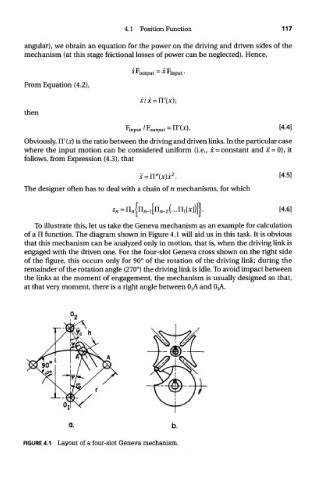
           To illustrate this, let us take the Geneva mechanism as an example for calculation
        of a n function. The diagram shown in Figure 4.1 will aid us in this task. It is obvious
        that this mechanism can be analyzed only in motion, that is, when the driving link is
        engaged with the driven one. For the four-slot Geneva cross shown on the right side
        of the figure, this occurs only for 90° of the rotation of the driving link; during the
        remainder of the rotation angle (270°) the driving link is idle. To avoid impact between
        the links at the moment of engagement, the mechanism is usually designed so that,
        at that very moment, there is a right angle between O tA and 0;A


        FIGURE 4.1 Layout of a four-slot Geneva mechanism.

