


Page 153 - Robotics Designing the Mechanisms for Automated Machinery
P. 153
4.3 Master Controller, Amplifiers                141


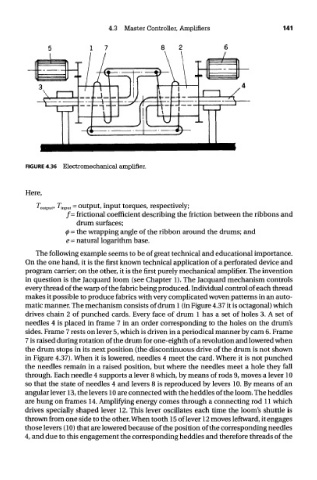
         FIGURE 4.36 Electromechanical amplifier.


         Here,
            r output, Tjuput = output, input torques, respectively;
                    /= frictional coefficient describing the friction between the ribbons and
                       drum surfaces;
                    <j) = the wrapping angle of the ribbon around the drums; and
                    e = natural logarithm base.

            The following example seems to be of great technical and educational importance.
         On the one hand, it is the first known technical application of a perforated device and
         program carrier; on the other, it is the first purely mechanical amplifier. The invention
         in question is the Jacquard loom (see Chapter 1). The Jacquard mechanism controls
         every thread of the warp of the fabric being produced. Individual control of each thread
         makes it possible to produce fabrics with very complicated woven patterns in an auto-
         matic manner. The mechanism consists of drum 1 (in Figure 4.37 it is octagonal) which
         drives chain 2 of punched cards. Every face of drum 1 has a set of holes 3. A set of
         needles 4 is placed in frame 7 in an order corresponding to the holes on the drum's
         sides. Frame 7 rests on lever 5, which is driven in a periodical manner by cam 6. Frame
         7 is raised during rotation of the drum for one-eighth of a revolution and lowered when
         the drum stops in its next position (the discontinuous drive of the drum is not shown
         in Figure 4.37). When it is lowered, needles 4 meet the card. Where it is not punched
         the needles remain in a raised position, but where the needles meet a hole they fall
         through. Each needle 4 supports a lever 8 which, by means of rods 9, moves a lever 10
         so that the state of needles 4 and levers 8 is reproduced by levers 10. By means of an
         angular lever 13, the levers 10 are connected with the heddles of the loom. The heddles
         are hung on frames 14. Amplifying energy comes through a connecting rod 11 which
         drives specially shaped lever 12. This lever oscillates each time the loom's shuttle is
         thrown from one side to the other. When tooth 15 of lever 12 moves leftward, it engages
         those levers (10) that are lowered because of the position of the corresponding needles
         4, and due to this engagement the corresponding heddles and therefore threads of the

