


Page 164 - Robotics Designing the Mechanisms for Automated Machinery
P. 164
152               Kinematics and Control of Automatic Machines

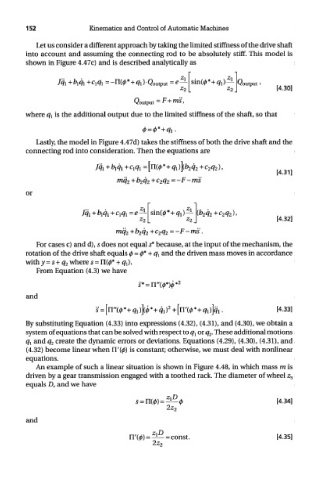
           Let us consider a different approach by taking the limited stiffness of the drive shaft
        into account and assuming the connecting rod to be absolutely stiff. This model is
        shown in Figure 4.47c) and is described analytically as


        where q t is the additional output due to the limited stiffness of the shaft, so that


           Lastly, the model in Figure 4.47d) takes the stiffness of both the drive shaft and the
        connecting rod into consideration. Then the equations are


        or


           For cases c) and d), s does not equal s* because, at the input of the mechanism, the
        rotation of the drive shaft equals 0 = 0* + q l and the driven mass moves in accordance
        with y = s + q 2 where 5 = n(0* + qj.
           From Equation (4.3) we have


        and


        By substituting Equation (4.33) into expressions (4.32), (4.31), and (4.30), we obtain a
        system of equations that can be solved with respect to q l or q 2. These additional motions
        q l and q 2 create the dynamic errors or deviations. Equations (4.29), (4.30), (4.31), and
         (4.32) become linear when IT(0) is constant; otherwise, we must deal with nonlinear
        equations.
           An example of such a linear situation is shown in Figure 4.48, in which mass m is
        driven by a gear transmission engaged with a toothed rack. The diameter of wheel z^
        equals D, and we have


        and

