


Page 161 - Robotics Designing the Mechanisms for Automated Machinery
P. 161
4.4 Dynamic Accuracy                          149

         chosen from among a very wide range of possibilities, and Figure 4.13 shows a partial
         graphical interpretation of a specific function with the displacement s, velocity s, and
         acceleration s. While the graph shows the ideal shapes of these kinematic character-
         istics, one can never actually achieve such curves, whatever the effort made to attain
         accuracy in manufacturing. And the reason for this pessimistic note is the limited stiff-
         ness of the links constituting the mechanism, with their deformation by external and
         inertial forces. These deformations are usually too small to significantly alter the shape
         of the displacement s(f). However, the first- and second-order derivatives, namely, the
         velocity s and especially the acceleration s, can (and usually do) acquire significant
         deflections or errors. Sometimes the errors in acceleration reach the order of magni-
         tude of the nominal acceleration.
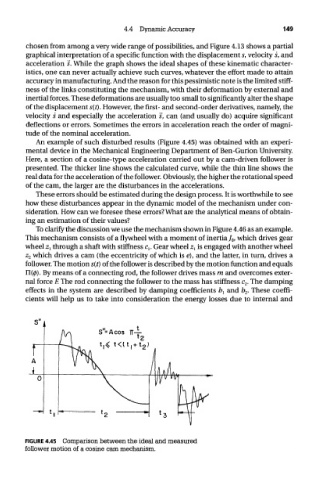
            An example of such disturbed results (Figure 4.45) was obtained with an experi-
         mental device in the Mechanical Engineering Department of Ben-Gurion University.
         Here, a section of a cosine-type acceleration carried out by a cam-driven follower is
         presented. The thicker line shows the calculated curve, while the thin line shows the
         real data for the acceleration of the follower. Obviously, the higher the rotational speed
         of the cam, the larger are the disturbances in the accelerations.
            These errors should be estimated during the design process. It is worthwhile to see
         how these disturbances appear in the dynamic model of the mechanism under con-
         sideration. How can we foresee these errors? What are the analytical means of obtain-
         ing an estimation of their values?
            To clarify the discussion we use the mechanism shown in Figure 4.46 as an example.
         This mechanism consists of a flywheel with a moment of inertia / 0, which drives gear
         wheel z l through a shaft with stiffness q. Gear wheel z l is engaged with another wheel
         z 2 which drives a cam (the eccentricity of which is e), and the latter, in turn, drives a
         follower. The motion s(f) of the follower is described by the motion function and equals
         11(0). By means of a connecting rod, the follower drives mass m and overcomes exter-
         nal force E The rod connecting the follower to the mass has stiffness c 2. The damping
         effects in the system are described by damping coefficients b l and b 2. These coeffi-
         cients will help us to take into consideration the energy losses due to internal and


         FIGURE 4.45 Comparison between the ideal and measured
         follower motion of a cosine cam mechanism.

