


Page 85 - Robotics Designing the Mechanisms for Automated Machinery
P. 85
74                         Dynamic Analysis of Drives

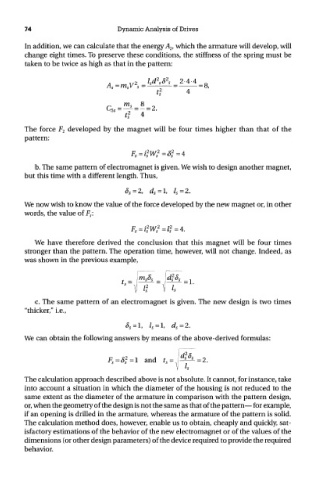
        In addition, we can calculate that the energy A 2, which the armature will develop, will
        change eight times. To preserve these conditions, the stiffness of the spring must be
        taken to be twice as high as that in the pattern:


        The force F 2 developed by the magnet will be four times higher than that of the
        pattern:


           b. The same pattern of electromagnet is given. We wish to design another magnet,
        but this time with a different length. Thus,


        We now wish to know the value of the force developed by the new magnet or, in other
        words, the value of F s:


           We have therefore derived the conclusion that this magnet will be four times
        stronger than the pattern. The operation time, however, will not change. Indeed, as
        was shown in the previous example,


           c. The same pattern of an electromagnet is given. The new design is two times
        "thicker," i.e.,


        We can obtain the following answers by means of the above-derived formulas:


        The calculation approach described above is not absolute. It cannot, for instance, take
        into account a situation in which the diameter of the housing is not reduced to the
        same extent as the diameter of the armature in comparison with the pattern design,
        or, when the geometry of the design is not the same as that of the pattern— for example,
        if an opening is drilled in the armature, whereas the armature of the pattern is solid.
        The calculation method does, however, enable us to obtain, cheaply and quickly, sat-
        isfactory estimations of the behavior of the new electromagnet or of the values of the
        dimensions (or other design parameters) of the device required to provide the required
        behavior.

