


Page 86 - Robotics Designing the Mechanisms for Automated Machinery
P. 86
3.3 Electric Drives                          75

        3.3     Electric Drives

           In this section we consider the behavior of electrically driven mechanical systems.
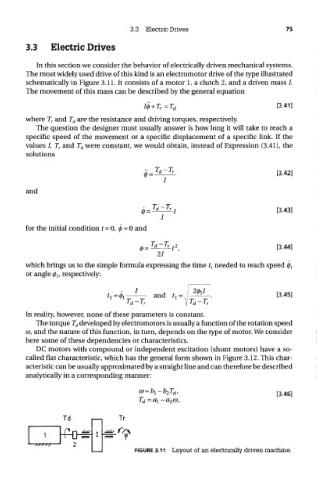
        The most widely used drive of this kind is an electromotor drive of the type illustrated
        schematically in Figure 3.11. It consists of a motor 1, a clutch 2, and a driven mass /.
        The movement of this mass can be described by the general equation


        where T r and T d are the resistance and driving torques, respectively.
           The question the designer must usually answer is how long it will take to reach a
        specific speed of the movement or a specific displacement of a specific link. If the
        values /, T r and T d were constant, we would obtain, instead of Expression (3.41), the
        solutions


        and


        for the initial condition t = 0, 0 = 0 and


        which brings us to the simple formula expressing the time ^ needed to reach speed ^
        or angle (j> lf respectively:


        In reality, however, none of these parameters is constant.
           The torque T d developed by electromotors is usually a function of the rotation speed
        CD, and the nature of this function, in turn, depends on the type of motor. We consider
        here some of these dependencies or characteristics.
           DC motors with compound or independent excitation (shunt motors) have a so-
        called flat characteristic, which has the general form shown in Figure 3.12. This char-
        acteristic can be usually approximated by a straight line and can therefore be described
        analytically in a corresponding manner:


                                        FIGURE 3.11 Layout of an electrically driven machine.

