


Page 127 - Rotating Machinery Pratical Solutions to Unbalance and Misalignment
P. 127
Advanced Machine Alignment

            ing the minimum torque value of the grade 5. If the grade 2 fas-
            tener were torqued to its maximum, it would produce a clamping
            force of only 67% of the minimum clamping force of the grade 5
            fastener.
                 Most often, fastener manufacturers state the recommended
            torque value for clean, dry threads. Any lubricant or debris on the
            threads will greatly effect the torque value.
                 A  very small amount of oil on the threads will reduce the
            friction significantly—enough to reduce the recommended torque
            by about 15% to 25%. Some of the newer Teflon- or Molybdenum-
            based dry type lubricants can reduce the torque required by as
            much as 50%. Often, zinc-plated fasteners can be found in indus-
            trial applications. This plating will reduce the amount of required
            torque by 15%.
                 Table 8-2 illustrates the tensile strength for various grades of
            fasteners.

                      Table 8-2. Properties of Various Grade Fasteners
            ————————————————————————————————
                                                              TENSILE
             GRADE                MATERIAL                STRENGTH (psi)
            ————————————————————————————————
                2                 Low carbon                   74,000
                5          Medium - carbon, tempered           120,000
                8    Medium - carbon, tempered & quenched      150,000
            ————————————————————————————————

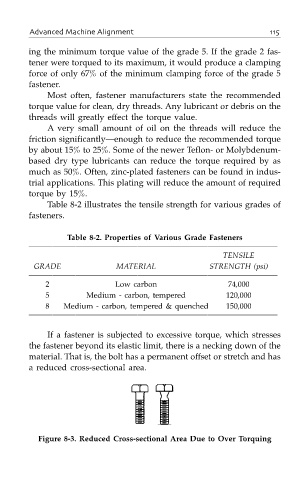
                 If a fastener is subjected to excessive torque, which stresses
            the fastener beyond its elastic limit, there is a necking down of the
            material. That is, the bolt has a permanent offset or stretch and has
            a reduced cross-sectional area.


              Figure 8-3. Reduced Cross-sectional Area Due to Over Torquing

