


Page 146 - Rotating Machinery Pratical Solutions to Unbalance and Misalignment
P. 146
Rotating Machinery: Practical Solutions

            growth or shrinkage is understood, the few extra minutes re-
            quired will assure the best possible final alignment.
                 Metals, like most materials, expand when heated. The
            amount they expand is expressed as the coefficient of thermal
            expansion. This coefficient is expressed as the change in length per
            degree of temperature rise. This is expressed mathematically as:


                 c = dL/dT                                              (8.1)

                 By rearranging Equation (8.1) the amount of thermal growth
            for a given length (L) can be expressed as:


                 dL = c × dT × L                                        (8.2)

                 Equation (8.2) states the change in length is equal to the dif-
            ference in temperature times the coefficient of thermal expansion
            times the original length.
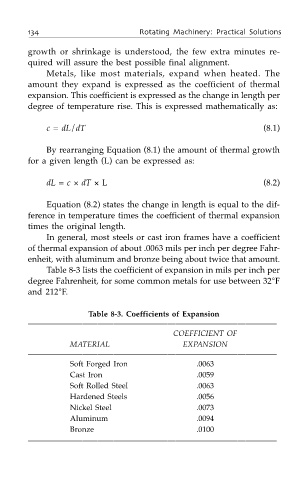
                 In general, most steels or cast iron frames have a coefficient
            of thermal expansion of about .0063 mils per inch per degree Fahr-
            enheit, with aluminum and bronze being about twice that amount.
                 Table 8-3 lists the coefficient of expansion in mils per inch per
            degree Fahrenheit, for some common metals for use between 32°F
            and 212°F.


                           Table 8-3. Coefficients of Expansion
            ————————————————————————————————
                                                 COEFFICIENT OF
                       MATERIAL                     EXPANSION
            ————————————————————————————————
                       Soft Forged Iron                .0063
                       Cast Iron                       .0059
                       Soft Rolled Steel               .0063
                       Hardened Steels                 .0056
                       Nickel Steel                    .0073
                       Aluminum                        .0094
                       Bronze                          .0100
            ————————————————————————————————

