


Page 398 - Satellite Communications, Fourth Edition
P. 398
378  Chapter Twelve

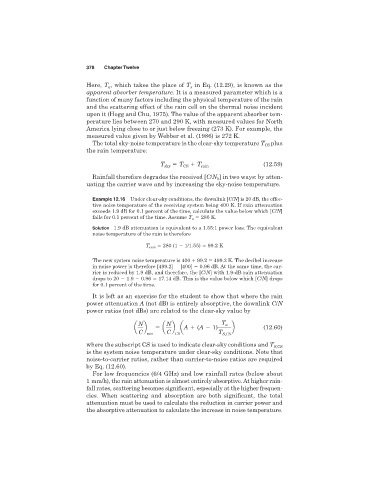
                              Here, T , which takes the place of T in Eq. (12.29), is known as the
                                                                x
                                     a
                              apparent absorber temperature. It is a measured parameter which is a
                              function of many factors including the physical temperature of the rain
                              and the scattering effect of the rain cell on the thermal noise incident
                              upon it (Hogg and Chu, 1975). The value of the apparent absorber tem-
                              perature lies between 270 and 290 K, with measured values for North
                              America lying close to or just below freezing (273 K). For example, the
                              measured value given by Webber et al. (1986) is 272 K.
                                The total sky-noise temperature is the clear-sky temperature T CS  plus
                              the rain temperature:

                                                      T sky    T CS    T rain           (12.59)

                                Rainfall therefore degrades the received [C/N ] in two ways: by atten-
                                                                         0
                              uating the carrier wave and by increasing the sky-noise temperature.

                                Example 12.16 Under clear-sky conditions, the downlink [C/N] is 20 dB, the effec-
                                tive noise temperature of the receiving system being 400 K. If rain attenuation
                                exceeds 1.9 dB for 0.1 percent of the time, calculate the value below which [C/N]
                                falls for 0.1 percent of the time. Assume T a   280 K.

                                Solution 1.9 dB attenuation is equivalent to a 1.55:1 power loss. The equivalent
                                noise temperature of the rain is therefore
                                                 T rain   280 (1   1/1.55)   99.2 K

                                The new system noise temperature is 400   99.2   499.2 K. The decibel increase
                                in noise power is therefore [499.2]   [400]   0.96 dB. At the same time, the car-
                                rier is reduced by 1.9 dB, and therefore, the [C/N] with 1.9-dB rain attenuation
                                drops to 20   1.9   0.96   17.14 dB. This is the value below which [C/N] drops
                                for 0.1 percent of the time.

                                It is left as an exercise for the student to show that where the rain
                              power attenuation A (not dB) is entirely absorptive, the downlink C/N
                              power ratios (not dBs) are related to the clear-sky value by

                                             a N b    a N b aA   (A   1)  T a  b        (12.60)
                                               C  rain  C  CS            T S,CS

                              where the subscript CS is used to indicate clear-sky conditions and T S,CS
                              is the system noise temperature under clear-sky conditions. Note that
                              noise-to-carrier ratios, rather than carrier-to-noise ratios are required
                              by Eq. (12.60).
                                For low frequencies (6/4 GHz) and low rainfall rates (below about
                              1 mm/h), the rain attenuation is almost entirely absorptive. At higher rain-
                              fall rates, scattering becomes significant, especially at the higher frequen-
                              cies. When scattering and absorption are both significant, the total
                              attenuation must be used to calculate the reduction in carrier power and
                              the absorptive attenuation to calculate the increase in noise temperature.

