


Page 427 - Satellite Communications, Fourth Edition
P. 427
Interference  407

                                It should be noted that no simple relationship can be given for calcu-
                              lating the effect of reduced orbital spacing on the overall [C/I]. The sep-
                              arate uplink and downlink values must be calculated and combined as
                              described in Sec. 13.2.3. Other telecommunications authorities specify
                              antenna characteristics that differ from the FCC specifications (see
                              CCIR Rep. 391–3, 1978).


                              13.2.5 Passband interference
                              In the preceding section, the carrier-to-interference ratio at the receiver
                              input is determined. However, the amount of interference reaching the
                              detector will depend on the amount of frequency overlap between the
                              interfering spectrum and the wanted channel passband.
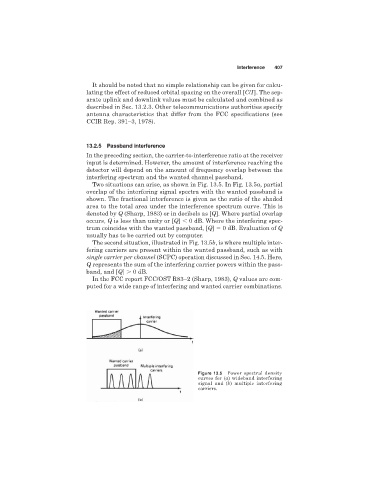
                                Two situations can arise, as shown in Fig. 13.5. In Fig. 13.5a, partial
                              overlap of the interfering signal spectra with the wanted passband is
                              shown. The fractional interference is given as the ratio of the shaded
                              area to the total area under the interference spectrum curve. This is
                              denoted by Q (Sharp, 1983) or in decibels as [Q]. Where partial overlap
                              occurs, Q is less than unity or [Q]   0 dB. Where the interfering spec-
                              trum coincides with the wanted passband, [Q]   0 dB. Evaluation of Q
                              usually has to be carried out by computer.
                                The second situation, illustrated in Fig. 13.5b, is where multiple inter-
                              fering carriers are present within the wanted passband, such as with
                              single carrier per channel (SCPC) operation discussed in Sec. 14.5. Here,
                              Q represents the sum of the interfering carrier powers within the pass-
                              band, and [Q]   0 dB.
                                In the FCC report FCC/OST R83–2 (Sharp, 1983), Q values are com-
                              puted for a wide range of interfering and wanted carrier combinations.


                                                                  Figure 13.5  Power spectral density
                                                                  curves for (a) wideband interfering
                                                                  signal and (b) multiple interfering
                                                                  carriers.

