


Page 430 - Satellite Communications, Fourth Edition
P. 430
410  Chapter Thirteen

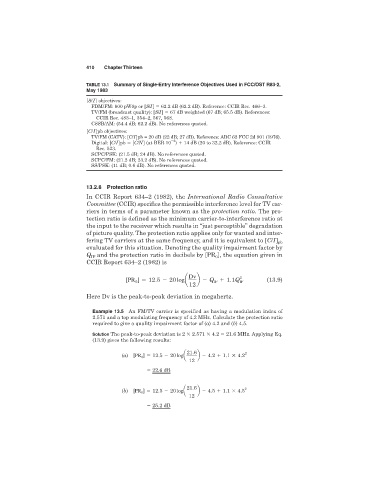
                              TABLE 13.1 Summary of Single-Entry Interference Objectives Used in FCC/OST R83-2,
                              May 1983
                              [S/I ] objectives:
                               FDM/FM: 600 pW0p or [S/I ]   62.2 dB (62.2 dB). Reference: CCIR Rec. 466–3.
                               TV/FM (broadcast quality): [S/I ]   67 dB weighted (67 dB; 65.5 dB). References:
                                 CCIR Rec. 483–1, 354–2, 567, 568.
                               CSSB/AM: (54.4 dB; 62.2 dB). No references quoted.
                              [C/I ]pb objectives:
                               TV/FM (CATV): [C/I]pb = 20 dB (22 dB; 27 dB). Reference: ABC 62 FCC 2d 901 (1976).
                                                           6
                               Digital: [C/I ]pb   [C/N] (at BER 10 )   14 dB (20 to 32.2 dB). Reference: CCIR
                                 Rec. 523.
                               SCPC/PSK: (21.5 dB; 24 dB). No references quoted.
                               SCPC/FM: (21.2 dB; 23.2 dB). No references quoted.
                               SS/PSK: (11 dB; 0.6 dB). No references quoted.


                              13.2.8 Protection ratio
                              In CCIR Report 634–2 (1982), the International Radio Consultative
                              Committee (CCIR) specifies the permissible interference level for TV car-
                              riers in terms of a parameter known as the protection ratio.The pro-
                              tection ratio is defined as the minimum carrier-to-interference ratio at
                              the input to the receiver which results in “just perceptible” degradation
                              of picture quality. The protection ratio applies only for wanted and inter-
                              fering TV carriers at the same frequency, and it is equivalent to [C/I] pb
                              evaluated for this situation. Denoting the quality impairment factor by
                              Q and the protection ratio in decibels by [PR ], the equation given in
                                                                        0
                               IF
                              CCIR Report 634–2 (1982) is
                                           [PR ]   12.5   20 loga Dv b   Q   1.1Q 2 IF   (13.9)
                                                                        IF
                                              0
                                                               12
                              Here Dv is the peak-to-peak deviation in megahertz.

                                Example 13.5 An FM/TV carrier is specified as having a modulation index of
                                2.571 and a top modulating frequency of 4.2 MHz. Calculate the protection ratio
                                required to give a quality impairment factor of (a) 4.2 and (b) 4.5.
                                Solution The peak-to-peak deviation is 2   2.571   4.2   21.6 MHz. Applying Eq.
                                (13.9) gives the following results:

                                         (a)  [PR 0 ]   12.5   20 loga 21.6 b   4.2   1.1   4.2 2
                                                               12
                                                   22.6 dB


                                         (b)  [PR 0 ]   12.5   20 loga 21.6 b   4.5   1.1   4.5 2
                                                               12
                                                   25.2 dB

