


Page 428 - Satellite Communications, Fourth Edition
P. 428
408  Chapter Thirteen

                              Typical [Q] values obtained from the FCC report are as follows: with the
                              wanted carrier a TV/FM signal and the interfering carrier a similar
                              TV/FM signal, [Q]   0 dB; with SCPC/PSK interfering carriers, [Q]
                              27.92 dB; and with the interfering carrier a wideband digital-type signal,
                              [Q]   3.36 dB.
                                The passband [C/I] ratio is calculated using

                                                     c C d    c  C d    [Q]              (13.7)
                                                      I  pb   I  ant

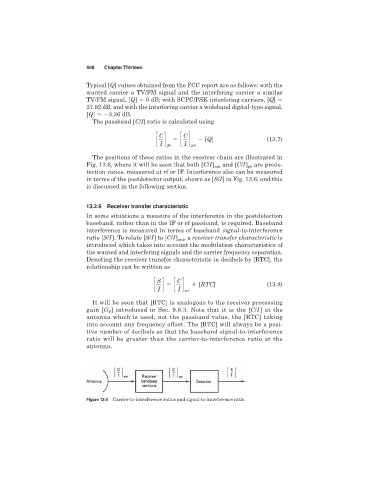
                                The positions of these ratios in the receiver chain are illustrated in
                                                                          and [C/I]  are prede-
                              Fig. 13.6, where it will be seen that both [C/I] ant  pb
                              tection ratios, measured at rf or IF. Interference also can be measured
                              in terms of the postdetector output, shown as [S/I] in Fig. 13.6, and this
                              is discussed in the following section.


                              13.2.6 Receiver transfer characteristic
                              In some situations a measure of the interference in the postdetection
                              baseband, rather than in the IF or rf passband, is required. Baseband
                              interference is measured in terms of baseband signal-to-interference
                              ratio [S/I]. To relate [S/I] to [C/I] ant , a receiver transfer characteristic is
                              introduced which takes into account the modulation characteristics of
                              the wanted and interfering signals and the carrier frequency separation.
                              Denoting the receiver transfer characteristic in decibels by [RTC], the
                              relationship can be written as


                                                     S
                                                    c d   c C d    [RTC]                 (13.8)
                                                     I      I  ant
                                It will be seen that [RTC] is analogous to the receiver processing
                              gain [G ] introduced in Sec. 9.6.3. Note that it is the [C/I] at the
                                     P
                              antenna which is used, not the passband value, the [RTC] taking
                              into account any frequency offset. The [RTC] will always be a posi-
                              tive number of decibels so that the baseband signal-to-interference
                              ratio will be greater than the carrier-to-interference ratio at the
                              antenna.


                              Figure 13.6 Carrier-to-interference ratios and signal-to-interference ratio.

