


Page 164 - Science at the nanoscale
P. 164
10:15
                                                     RPS: PSP0007 - Science-at-Nanoscale
                   June 5, 2009
                              Formation and Self-Assembly at the Nanoscale
                         154
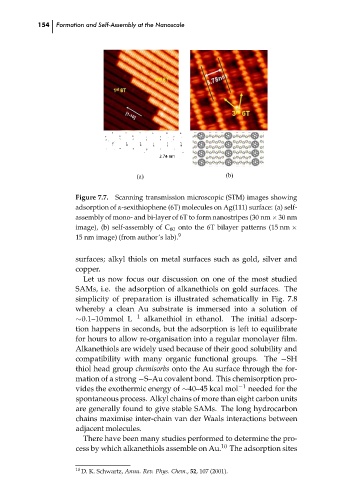
                                             Scanning transmission microscopic (STM) images showing
                                   Figure 7.7.
                                   adsorption of α-sexithiophene (6T) molecules on Ag(111) surface: (a) self-
                                   assembly of mono- and bi-layer of 6T to form nanostripes (30 nm × 30 nm
                                   image), (b) self-assembly of C 60 onto the 6T bilayer patterns (15 nm ×
                                                              9
                                   15 nm image) (from author’s lab).
                                   surfaces; alkyl thiols on metal surfaces such as gold, silver and
                                   copper.
                                     Let us now focus our discussion on one of the most studied
                                   SAMs, i.e. the adsorption of alkanethiols on gold surfaces. The
                                   simplicity of preparation is illustrated schematically in Fig. 7.8
                                   whereby a clean Au substrate is immersed into a solution of
                                                  −1
                                                     alkanethiol in ethanol.
                                   ∼0.1–10mmol L
                                                                           The initial adsorp-
                                   tion happens in seconds, but the adsorption is left to equilibrate
                                   for hours to allow re-organisation into a regular monolayer film.  ch07
                                   Alkanethiols are widely used because of their good solubility and
                                   compatibility with many organic functional groups. The −SH
                                   thiol head group chemisorbs onto the Au surface through the for-
                                   mation of a strong −S–Au covalent bond. This chemisorption pro-
                                   vides the exothermic energy of ∼40–45 kcal mol −1  needed for the
                                   spontaneous process. Alkyl chains of more than eight carbon units
                                   are generally found to give stable SAMs. The long hydrocarbon
                                   chains maximise inter-chain van der Waals interactions between
                                   adjacent molecules.
                                     There have been many studies performed to determine the pro-
                                   cess by which alkanethiols assemble on Au. 10  The adsorption sites
                                   10  D. K. Schwartz, Annu. Rev. Phys. Chem., 52, 107 (2001).

