


Page 165 - Science at the nanoscale
P. 165
RPS: PSP0007 - Science-at-Nanoscale
                             10:15
                   June 5, 2009
                                                                    7.3. The Self-Assembly Processes
                                                   Au
                                                   Thiol solution
                                            Adsorption
                                           Organisation
                                                                 Au
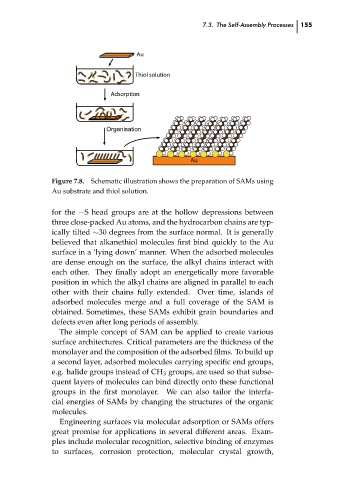
                             Figure 7.8. Schematic illustration shows the preparation of SAMs using
                             Au substrate and thiol solution.
                             for the −S head groups are at the hollow depressions between
                             three close-packed Au atoms, and the hydrocarbon chains are typ-
                             ically tilted ∼30 degrees from the surface normal. It is generally
                             believed that alkanethiol molecules first bind quickly to the Au
                             surface in a ‘lying down’ manner. When the adsorbed molecules
                             are dense enough on the surface, the alkyl chains interact with
                             each other. They finally adopt an energetically more favorable
                             position in which the alkyl chains are aligned in parallel to each
                             other with their chains fully extended. Over time, islands of
                             adsorbed molecules merge and a full coverage of the SAM is
                             obtained. Sometimes, these SAMs exhibit grain boundaries and
                             defects even after long periods of assembly.
                               The simple concept of SAM can be applied to create various
                             surface architectures. Critical parameters are the thickness of the  155  ch07
                             monolayer and the composition of the adsorbed films. To build up
                             a second layer, adsorbed molecules carrying specific end groups,
                             e.g. halide groups instead of CH 3 groups, are used so that subse-
                             quent layers of molecules can bind directly onto these functional
                             groups in the first monolayer. We can also tailor the interfa-
                             cial energies of SAMs by changing the structures of the organic
                             molecules.
                               Engineering surfaces via molecular adsorption or SAMs offers
                             great promise for applications in several different areas. Exam-
                             ples include molecular recognition, selective binding of enzymes
                             to surfaces, corrosion protection, molecular crystal growth,

