


Page 166 - Science at the nanoscale
P. 166
10:15
                                                     RPS: PSP0007 - Science-at-Nanoscale
                   June 5, 2009
                              Formation and Self-Assembly at the Nanoscale
                         156
                                   biosensing devices, etc. The self-assembly process is one of the
                                   most general strategies available for the formation of regular
                                   nanostructures.
                                          Self-assembly of Nano-sized Components
                                   7.3.3
                                   In principle, components of any size can self-assemble just like
                                   molecules when the thermodynamic conditions are met. A com-
                                   mon example is the precious opal, which is basically a self-
                                   assembly of quartz particles ∼150 to 300 nm in diameter. These
                                   spherical particles adopt a close-packed hexagonal order in crys-
                                                  The size distributions and packing order of
                                   talline phase.
                                   these particles determine the colour and quality of the precious
                                   opal. Light waves scattered from the planes of particles produce
                                   interference patterns, thus giving opal its beautiful and iridescent
                                   appearance.
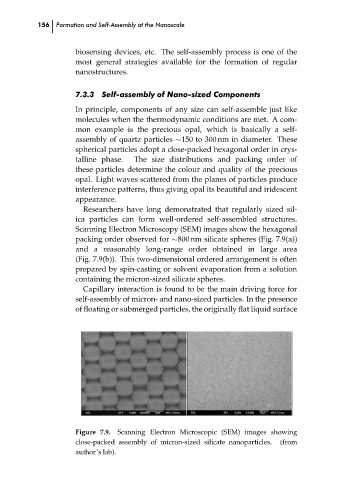
                                     Researchers have long demonstrated that regularly sized sil-
                                   ica particles can form well-ordered self-assembled structures.
                                   Scanning Electron Microscopy (SEM) images show the hexagonal
                                   packing order observed for ∼800 nm silicate spheres (Fig. 7.9(a))
                                   and a reasonably long-range order obtained in large area
                                   (Fig. 7.9(b)). This two-dimensional ordered arrangement is often
                                   prepared by spin-casting or solvent evaporation from a solution
                                   containing the micron-sized silicate spheres.
                                     Capillary interaction is found to be the main driving force for
                                   self-assembly of micron- and nano-sized particles. In the presence
                                   of floating or submerged particles, the originally flat liquid surface
                                   Figure 7.9.  Scanning Electron Microscopic (SEM) images showing  ch07
                                   close-packed assembly of micron-sized silicate nanoparticles.  (from
                                   author’s lab).

