


Page 167 - Science at the nanoscale
P. 167
10:15
                   June 5, 2009
                                                                    7.3. The Self-Assembly Processes
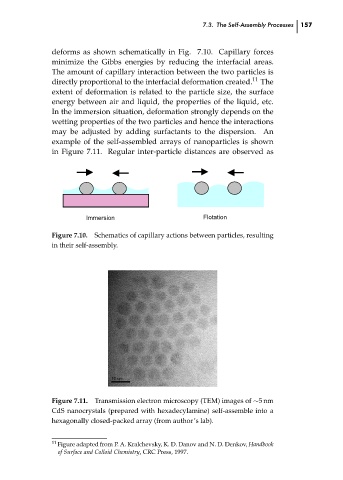
                             deforms as shown schematically in Fig. 7.10. Capillary forces
                             minimize the Gibbs energies by reducing the interfacial areas.
                             The amount of capillary interaction between the two particles is
                             directly proportional to the interfacial deformation created.
                             extent of deformation is related to the particle size, the surface
                             energy between air and liquid, the properties of the liquid, etc.
                             In the immersion situation, deformation strongly depends on the
                             wetting properties of the two particles and hence the interactions
                             may be adjusted by adding surfactants to the dispersion. An
                             example of the self-assembled arrays of nanoparticles is shown
                             in Figure 7.11. Regular inter-particle distances are observed as
                                                                    Flotation
                             Figure 7.10.
                                        Schematics of capillary actions between particles, resulting
                             in their self-assembly.
                                        Transmission electron microscopy (TEM) images of ∼5 nm
                             Figure 7.11. Immersion  RPS: PSP0007 - Science-at-Nanoscale  11  The  157  ch07
                             CdS nanocrystals (prepared with hexadecylamine) self-assemble into a
                             hexagonally closed-packed array (from author’s lab).
                             11  Figure adapted from P. A. Kralchevsky, K. D. Danov and N. D. Denkov, Handbook
                              of Surface and Colloid Chemistry, CRC Press, 1997.

