


Page 171 - Science at the nanoscale
P. 171
RPS: PSP0007 - Science-at-Nanoscale
                             10:16
                   June 5, 2009
                             are designed to work in the visible light regime (400–700nm), the
                             smallest features that are resolvable are about the size of half the
                             wavelength of light used (approx. 200 nm). In order words, any
                             two features that are closer than half the wavelength of the light
                             would be regarded as a single feature. Thus optical microscopes
                             have limited resolution in the nanoscale regime.
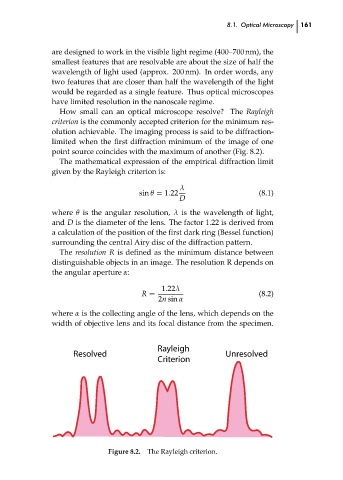
                               How small can an optical microscope resolve? The Rayleigh
                             criterion is the commonly accepted criterion for the minimum res-
                             olution achievable. The imaging process is said to be diffraction-
                             limited when the first diffraction minimum of the image of one
                             point source coincides with the maximum of another (Fig. 8.2).
                               The mathematical expression of the empirical diffraction limit
                             given by the Rayleigh criterion is:
                                                              λ
                                                                                   (8.1)
                                                    sin θ = 1.22
                                                              D
                             where θ is the angular resolution, λ is the wavelength of light,
                             and D is the diameter of the lens. The factor 1.22 is derived from
                             a calculation of the position of the first dark ring (Bessel function)
                             surrounding the central Airy disc of the diffraction pattern.
                               The resolution R is defined as the minimum distance between
                             distinguishable objects in an image. The resolution R depends on
                             the angular aperture α:
                                                         1.22λ
                                                                                   (8.2)
                                                    R =
                                                         2n sin α
                             where α is the collecting angle of the lens, which depends on the
                             width of objective lens and its focal distance from the specimen.
                                                        Rayleigh          8.1. Optical Microscopy  161  ch08
                                  Resolved                                Unresolved
                                                        Criterion
                                            Figure 8.2.  The Rayleigh criterion.

