


Page 173 - Science at the nanoscale
P. 173
RPS: PSP0007 - Science-at-Nanoscale
                             10:16
                   June 5, 2009
                                                                          8.2. Electron Microscopy
                                    Scanning Electron Microscopy
                             8.2.1
                             Efforts put into the development of electron microscopy have paid
                             off as the electron microscopes can achieve better resolution and
                             greater depth of focus. Why does an electron microscope achieve
                             better resolution? Scanning electron microscope uses electrons
                             with energies of a few thousand electron volts (eV). The de Broglie
                             wavelength of an electron is given by λ = h/p, where h is Planck’s
                             constant and p is the momentum of the electron. For electrons
                             with energy of 3600eV, the wavelength is 0.02 nm. Hence the elec-
                             tron microscope would be able to achieve much better resolution
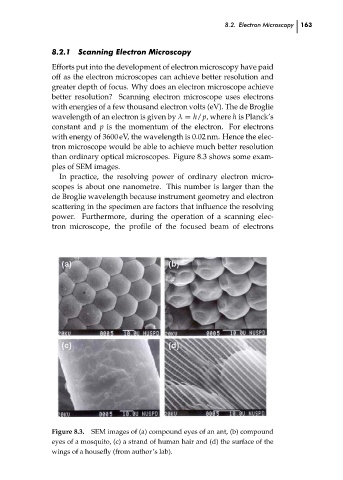
                             than ordinary optical microscopes. Figure 8.3 shows some exam-
                             ples of SEM images.
                               In practice, the resolving power of ordinary electron micro-
                             scopes is about one nanometre. This number is larger than the
                             de Broglie wavelength because instrument geometry and electron
                             scattering in the specimen are factors that influence the resolving
                             power. Furthermore, during the operation of a scanning elec-
                             tron microscope, the profile of the focused beam of electrons
                             Figure 8.3.  SEM images of (a) compound eyes of an ant, (b) compound  163  ch08
                             eyes of a mosquito, (c) a strand of human hair and (d) the surface of the
                             wings of a housefly (from author’s lab).

