


Page 178 - Science at the nanoscale
P. 178
10:16
                                                     RPS: PSP0007 - Science-at-Nanoscale
                   June 5, 2009
                              Nanotools and Nanofabrication
                         168
                                   traveling through the SEM column. The objective lens focuses
                                                                             The focal length
                                   the electron beam onto the sample surface.
                                   of the objective lens is denoted as the working distance of the
                                   microscope.
                                     The scanning of the electron beam over the surface of the sam-
                                   ple is achieved by deflecting the beam using an applied electric
                                   field or magnetic field. Typically a deflection coil consists of four
                                   radially oriented coils arranged so that the magnetic field is per-
                                   pendicular to the axis of the system. The magnetic field generated
                                   by these coils can be controlled by the amount of electric cur-
                                   rent passing through these coils. By programming these scanning
                                   coils, one can readily raster the electron beam over the sample sur-
                                   face.
                                     The typical accelerating voltage used in a SEM is of the order
                                   of a few thousand volts. With an energetic beam of electrons
                                   scanning over the sample surface, a number of phenomena occur
                                   due to the interaction between the electrons and sample atoms.
                                   The incident electrons can collide with the electrons of the atoms,
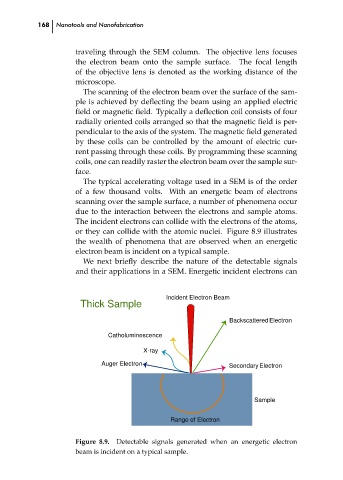
                                   or they can collide with the atomic nuclei. Figure 8.9 illustrates
                                   the wealth of phenomena that are observed when an energetic
                                   electron beam is incident on a typical sample.
                                     We next briefly describe the nature of the detectable signals
                                   and their applications in a SEM. Energetic incident electrons can
                                    Thick Sample
                                           Catholuminescence  Incident Electron Beam Backscattered Electron  ch08
                                                     X-ray
                                          Auger Electron                   Secondary Electron
                                                                                  Sample
                                                            Range of Electron
                                   Figure 8.9.  Detectable signals generated when an energetic electron
                                   beam is incident on a typical sample.

