


Page 181 - Science at the nanoscale
P. 181
RPS: PSP0007 - Science-at-Nanoscale
                             10:16
                   June 5, 2009
                                                                          8.2. Electron Microscopy
                             (AE). The AE has a characteristic energy, unique to each element
                             from which it was emitted. AE has relatively low energy and are
                             only emitted from the surface of the specimen, typically from a
                             depth of <3 nm, thereby yielding surface sensitive compositional
                             information. Hence, both EDX and Auger electron spectroscopy
                             are used for elemental analysis or chemical characterisation of a
                             sample.
                               Light is also emitted when a sample is being bombarded with
                             electrons. Many substances give out light when bombarded with
                             electrons, just like a TV monitor. This effect can be exploited for
                             imaging. The light emitted can be in the ultra-violet, visible or
                             infrared range and this phenomenon is referred to as Catholumi-
                             nescence (CL).
                               The SEM generates an image of the sample by scanning the elec-
                             trons over the sample surface while a SE detector placed near
                             the sample collects the signal generated. Modern SEMs have
                             incorporated many attractive technical features so that imaging
                             with a SEM has become very user friendly. The images are gen-
                             erated almost real time and high quality images can be stored
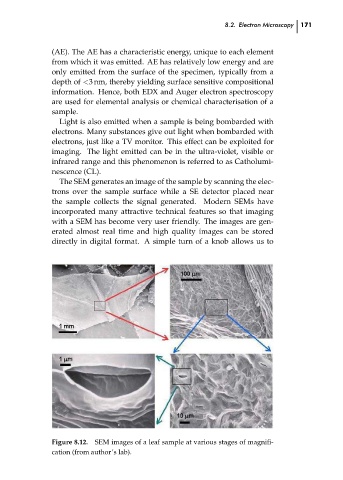
                             directly in digital format. A simple turn of a knob allows us to
                             Figure 8.12.  SEM images of a leaf sample at various stages of magnifi-  171  ch08
                             cation (from author’s lab).

