


Page 183 - Science at the nanoscale
P. 183
10:16
                   June 5, 2009
                                                                          8.2. Electron Microscopy
                             High Resolution TEM (HRTEM) is now routinely used to achieve
                             atomic resolution of a sample. However, TEM has its limitations.
                             Lengthy sample preparation is usually required to make the sam-
                             ple thin enough. Since the beam is traveling through the sample,
                             the sample bulk and not the surface is being imaged.
                             How does a TEM work?
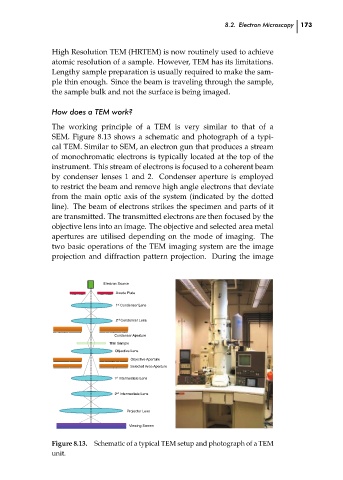
                             The working principle of a TEM is very similar to that of a
                             SEM. Figure 8.13 shows a schematic and photograph of a typi-
                             cal TEM. Similar to SEM, an electron gun that produces a stream
                             of monochromatic electrons is typically located at the top of the
                             instrument. This stream of electrons is focused to a coherent beam
                             by condenser lenses 1 and 2. Condenser aperture is employed
                             to restrict the beam and remove high angle electrons that deviate
                             from the main optic axis of the system (indicated by the dotted
                             line). The beam of electrons strikes the specimen and parts of it
                             are transmitted. The transmitted electrons are then focused by the
                             objective lens into an image. The objective and selected area metal
                             apertures are utilised depending on the mode of imaging. The
                             two basic operations of the TEM imaging system are the image
                             projection and diffraction pattern projection. During the image
                                          Electron Source
                                              Anode Plate
                                             1 st  Condenser Lens
                                             2 nd Condenser Lens
                                             Condenser Aperture RPS: PSP0007 - Science-at-Nanoscale  173  ch08
                                            Thin Sample
                                             Objective Lens
                                                 Objective Aperture
                                                 Selected Area Aperture
                                             1 st  Intermediate Lens
                                             2 nd  Intermediate Lens
                                                Projector Lens
                                                 Viewing Screen
                                       ------------------------------------------------------------------------------------
                             Figure 8.13.  Schematic of a typical TEM setup and photograph of a TEM
                             unit.

