


Page 179 - Science at the nanoscale
P. 179
RPS: PSP0007 - Science-at-Nanoscale
                             10:16
                   June 5, 2009
                                                                          8.2. Electron Microscopy
                             collide with the electrons in the sample and knock them out of
                             their usual orbits. These electrons are known as Secondary Elec-
                             trons (SE). During the process, the incident electron loses little
                             energy and continues to generate more SE as it travels further
                             into the sample. A single incident electron will typically gener-
                             ate a shower of thousands of SE until the incident electron loses
                             its energy. Since a large number of SE are generated, the detec-
                             tion of SE is the most common mode of operation for SEM sample
                             imaging. Note that the SE have low energies so that SE generated
                             deep in the sample are unable to travel to the surface and leave
                             the sample. As a result, the SE detected are primarily from region
                             close to the sample surface (<10nm). Hence SE imaging would
                             produces good topographical information of the sample.
                               Sometimes an incident electron collides with the nucleus of a
                             sample atom, causing the electron to bounce back. Such electrons
                             are referred to as Backscattered Electrons (BE). Since the atomic
                             nucleus is more massive than the electron, the BE has high veloc-
                             ity and is characterized by its high energy (a few keV). High den-
                             sity samples will generally create more BE, and hence BE imaging
                             can be utilized to identify differences in the densities of a sam-
                             ple. The production of BE varies directly with the atomic num-
                             ber of the atoms in the sample. Therefore regions with atoms of
                             higher atomic number would appear brighter than regions with
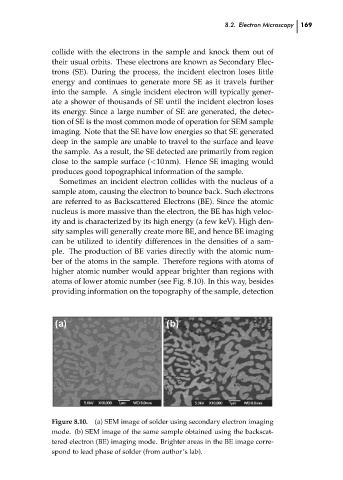
                             atoms of lower atomic number (see Fig. 8.10). In this way, besides
                             providing information on the topography of the sample, detection
                             Figure 8.10.  (a) SEM image of solder using secondary electron imaging  169  ch08
                             mode. (b) SEM image of the same sample obtained using the backscat-
                             tered electron (BE) imaging mode. Brighter areas in the BE image corre-
                             spond to lead phase of solder (from author’s lab).

