


Page 184 - Science at the nanoscale
P. 184
10:16
                                                     RPS: PSP0007 - Science-at-Nanoscale
                   June 5, 2009
                              Nanotools and Nanofabrication
                         174
                                   projection mode, the objective aperture is engaged and it enhances
                                   contrast by blocking high-angle diffracted electrons. During the
                                   diffraction pattern projection mode, the selected area aperture is
                                   engaged and it facilitates the examination of the periodic diffrac-
                                   tion of electrons caused by the interaction of the electrons with
                                   the ordered arrangements of atoms in the sample. The formed
                                   image then passes along the TEM column through the intermedi-
                                   ate and projector lenses before it strikes the fluorescent screen. In
                                   the image projection mode, the darker areas of the image repre-
                                   sent those areas of the sample that fewer electrons are transmit-
                                   ted through (thicker or denser); the lighter areas represent those
                                   areas that more electrons are transmitted through (thinner or less
                                   dense).
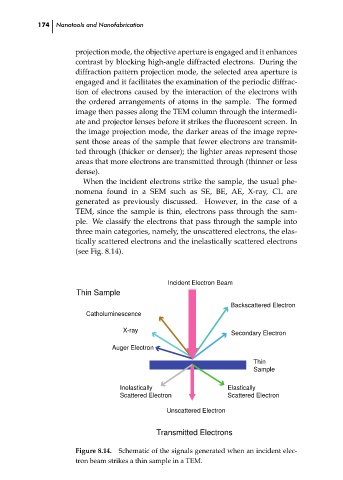
                                     When the incident electrons strike the sample, the usual phe-
                                   nomena found in a SEM such as SE, BE, AE, X-ray, CL are
                                   generated as previously discussed. However, in the case of a
                                   TEM, since the sample is thin, electrons pass through the sam-
                                   ple. We classify the electrons that pass through the sample into
                                   three main categories, namely, the unscattered electrons, the elas-
                                   tically scattered electrons and the inelastically scattered electrons
                                   (see Fig. 8.14).
                                   Thin Sample
                                      Catholuminescence
                                               X-ray
                                                                           Secondary Electron
                                             Auger Electron  Incident Electron Beam Backscattered Electron  ch08
                                                                                 Thin
                                                                                 Sample
                                               Inelastically               Elastically
                                               Scattered Electron          Scattered Electron
                                                           Unscattered Electron
                                                        Transmitted Electrons
                                   Figure 8.14.  Schematic of the signals generated when an incident elec-
                                   tron beam strikes a thin sample in a TEM.

