


Page 189 - Science at the nanoscale
P. 189
RPS: PSP0007 - Science-at-Nanoscale
                             10:16
                   June 5, 2009
                                                                    8.3. Scanning Probe Microscopy
                             of the sample with proper biasing, electrons will tunnel across the
                             gap between the atom at the tip and the atom of sample located
                             directly underneath the tip.
                                                         The magnitude of the tunneling
                             current (I) depends exponentially on the distance (d) between the
                             probing atom and the sample.
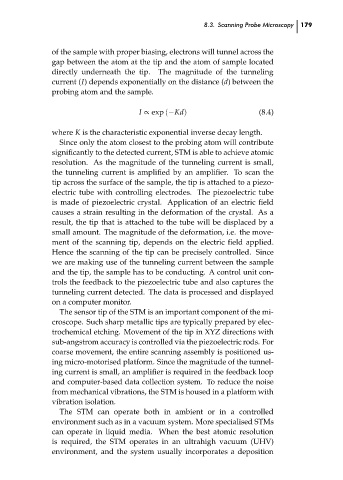
                                                                                   (8.4)
                                                    I ∝ exp (−Kd)
                             where K is the characteristic exponential inverse decay length.
                               Since only the atom closest to the probing atom will contribute
                             significantly to the detected current, STM is able to achieve atomic
                             resolution. As the magnitude of the tunneling current is small,
                             the tunneling current is amplified by an amplifier. To scan the
                             tip across the surface of the sample, the tip is attached to a piezo-
                             electric tube with controlling electrodes. The piezoelectric tube
                             is made of piezoelectric crystal. Application of an electric field
                             causes a strain resulting in the deformation of the crystal. As a
                             result, the tip that is attached to the tube will be displaced by a
                             small amount. The magnitude of the deformation, i.e. the move-
                             ment of the scanning tip, depends on the electric field applied.
                             Hence the scanning of the tip can be precisely controlled. Since
                             we are making use of the tunneling current between the sample
                             and the tip, the sample has to be conducting. A control unit con-
                             trols the feedback to the piezoelectric tube and also captures the
                             tunneling current detected. The data is processed and displayed
                             on a computer monitor.
                               The sensor tip of the STM is an important component of the mi-
                             croscope. Such sharp metallic tips are typically prepared by elec-
                             trochemical etching. Movement of the tip in XYZ directions with
                             sub-angstrom accuracy is controlled via the piezoelectric rods. For  179  ch08
                             coarse movement, the entire scanning assembly is positioned us-
                             ing micro-motorised platform. Since the magnitude of the tunnel-
                             ing current is small, an amplifier is required in the feedback loop
                             and computer-based data collection system. To reduce the noise
                             from mechanical vibrations, the STM is housed in a platform with
                             vibration isolation.
                               The STM can operate both in ambient or in a controlled
                             environment such as in a vacuum system. More specialised STMs
                             can operate in liquid media. When the best atomic resolution
                             is required, the STM operates in an ultrahigh vacuum (UHV)
                             environment, and the system usually incorporates a deposition

