


Page 191 - Science at the nanoscale
P. 191
RPS: PSP0007 - Science-at-Nanoscale
                             10:16
                   June 5, 2009
                                                                    8.3. Scanning Probe Microscopy
                               Top layer
                               Second layer
                               Third layer
                                            (a)
                                                                           (b)
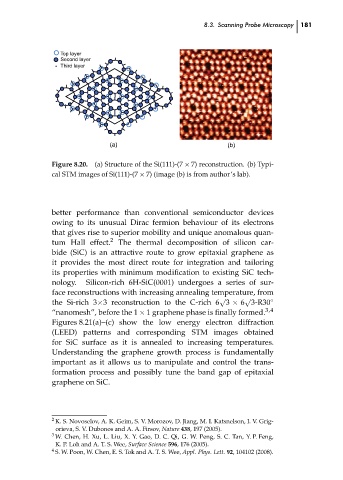
                             Figure 8.20.
                                        (a) Structure of the Si(111)-(7 × 7) reconstruction. (b) Typi-
                             cal STM images of Si(111)-(7 × 7) (image (b) is from author’s lab).
                             better performance than conventional semiconductor devices
                             owing to its unusual Dirac fermion behaviour of its electrons
                             that gives rise to superior mobility and unique anomalous quan-
                                            2
                                              The thermal decomposition of silicon car-
                             tum Hall effect.
                             bide (SiC) is an attractive route to grow epitaxial graphene as
                             it provides the most direct route for integration and tailoring
                             its properties with minimum modification to existing SiC tech-
                                      Silicon-rich 6H-SiC(0001) undergoes a series of sur-
                             nology.
                             face reconstructions with increasing annealing temperature, from
                                                                               √
                                                                        √
                             the Si-rich 3×3 reconstruction to the C-rich 6 3 × 6 3-R30
                                                                                      ◦
                                                                                    3,4
                             “nanomesh”, before the 1 × 1 graphene phase is finally formed.
                             Figures 8.21(a)–(c) show the low energy electron diffraction
                             (LEED) patterns and corresponding STM images obtained
                             for SiC surface as it is annealed to increasing temperatures.   181   ch08
                             Understanding the graphene growth process is fundamentally
                             important as it allows us to manipulate and control the trans-
                             formation process and possibly tune the band gap of epitaxial
                             graphene on SiC.
                             2  K. S. Novoselov, A. K. Geim, S. V. Morozov, D. Jiang, M. I. Katsnelson, I. V. Grig-
                              orieva, S. V. Dubonos and A. A. Firsov, Nature 438, 197 (2005).
                             3  W. Chen, H. Xu, L. Liu, X. Y. Gao, D. C. Qi, G. W. Peng, S. C. Tan, Y. P. Feng,
                              K. P. Loh and A. T. S. Wee, Surface Science 596, 176 (2005).
                             4  S. W. Poon, W. Chen, E. S. Tok and A. T. S. Wee, Appl. Phys. Lett. 92, 104102 (2008).

